
Best exercises for double and triple articulation in wind instruments.
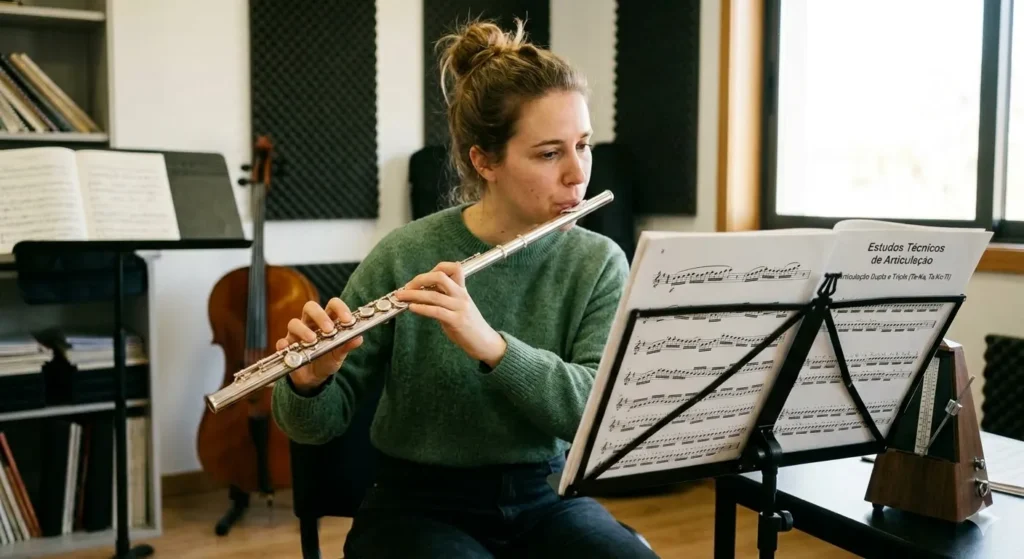
Exercises for double and triple articulation They are not merely a technical skill; in practice, they are the dividing line between playing fast notes and truly articulating them with intention, clarity, and musicality.
Advertisements
Anyone who has tried to play fast passages on wind instruments knows: it's not enough to just "go fast." There's a physical limit that, without proper technique, hinders the flow and compromises the sound. That's precisely where these articulations come in.
In this guide, you will understand how these techniques truly work, which exercises make a difference in daily practice, and how to transform mechanical repetition into consistent musical mastery.
What are double and triple articulation in wind instruments?
Double and triple articulation arises from practical necessity: playing fast without losing definition. Instead of relying on a single tongue strike, the musician alternates syllables, distributing the effort.
In double articulation, combinations such as "tu-ku" or "ta-ka" emerge. In triple articulation, patterns like "tu-tu-ku" create natural groupings, often used in more complex musical phrases.
Advertisements
It may seem like a minor detail, but it's not. This alternation completely changes the efficiency of tongue movement, allowing for more speed with less tension, and this directly impacts the sound.
How do these exercises improve performance?
At first, everything seems a bit awkward. The "ku" sounds weaker, the timing fluctuates, and the coordination simply doesn't keep up. It's normal and, in fact, expected.
With targeted practice, the tongue begins to respond more precisely, air flows continuously, and the sound stops "breaking" between articulations. It's a fine-tuning process that happens gradually.
To work Exercises for double and triple joint mobility. Consistency creates a solid foundation: less effort, more control, and, most importantly, more safety on fast sections.
Why does mastering these joints change your level?
There comes a point in any musician's evolution when the limitation ceases to be musical and becomes physical. The idea is there, but the body can't keep up.
Without efficient articulation, fast passages become sonic blurs. And this is often misinterpreted as a lack of musicality, when in fact it is a technical issue.
Mastering these articulations not only expands your repertoire but also improves the overall clarity of your execution. It's like adjusting the focus of a lens: everything starts to make more sense.
What are the best exercises for double joint mobility?
The most honest starting point is simple: alternate "tu-ku" on a single note, with a slow metronome. It seems basic, and that's precisely why it works.
The idea here is not speed, but equality. If the "tu" sounds stronger than the "ku," something needs to be adjusted. This imbalance is common and requires patient attention.
Next, apply this pattern to scales. Moving up and down while maintaining alternating articulation forces the brain to integrate tongue and fingers, and that's where the study starts to get interesting.
Read more: Mistakes that ruin the sound of your instrument
What are the best exercises for the triple joint?
Triple articulation requires a bit more mental organization. It's not enough to alternate; you need to group them. Patterns like "tu-tu-ku" help to structure this clearly.
A good exercise is to divide long notes into groups of three attacks, maintaining a continuous airflow. Without this, the sound loses sustain and the articulation becomes choppy.
Over time, applying these patterns to arpeggios presents a real challenge: maintaining precision without sacrificing musicality. It is at this point that technique and expression begin to meet.
When should you practice these exercises?
There's a detail that many people ignore: the timing of the study directly influences the result. Working on joint exercises with tired muscles often leads to bad habits.
Ideally, these exercises should be incorporated right after warming up, when the body is still responsive and alert. A few well-executed minutes are worth more than long, unfocused repetitions.
To maintain Exercises for double and triple joint mobility. In daily routines, even in short sessions, consistency is key, and consistency is everything here.
Comparative table of practical exercises
| Type of exercise | Main objective | Recommended level | Suggested frequency |
|---|---|---|---|
| Slow “tu-ku” alternation | Initial coordination | Beginner | Daily (5-10 min) |
| Articulated scales | Language and finger integration | Intermediary | 4 times a week |
| Triple arpeggios | Rhythmic precision | Intermediary | 3 times a week |
| Studies with a metronome | Time control | All | Daily |
| Applied repertoire | Musicality and fluidity | Advanced | 3 times a week |
This type of structure is not random. Conservatories and traditional schools use similar routines precisely because they work, even though each musician needs to adapt to their own rhythm.
How can you improve without developing bad technical habits?
Here's a tricky point: repeating something doesn't mean improving it. Repeating it incorrectly, in fact, accelerates the problem. And this happens more often than you might think.
Recording your own study time might seem uncomfortable, but it reveals details that often go unnoticed. Small inconsistencies become evident when you listen to yourself from the outside.
What mistakes should be avoided during practice?
Haste is undoubtedly the most common mistake. Increasing the pace before consolidating clarity creates a false sense of progress that crumbles later.
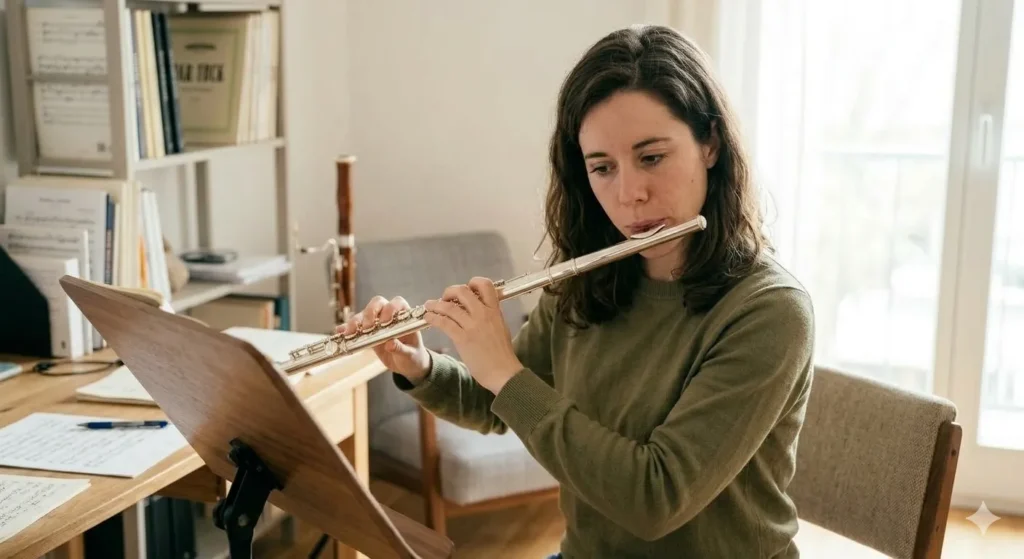
Another recurring problem is tension. When the tongue and jaw become stiff, the sound loses fluidity and the effort increases. It's a cycle that hinders progress.
Ignoring the metronome also compromises the process. Without a time reference, the articulation may sound good, but it will hardly be consistent.
How can we incorporate these exercises into our repertoire?
There is an important transition between studying and actually playing music. Getting stuck only on technical exercises limits artistic development.
Apply Exercises for double and triple joint mobility. In real-life scenarios, the perception changes completely. The study ceases to be mechanical and takes on a musical intention.
Choosing pieces that challenge articulation is a natural progression. Gradually, what once seemed impossible begins to become part of the instrument's vocabulary.
Conclusion
Double and triple articulation is not a technical "extra," it is a central part of mastering the technique. wind instruments. Ignoring this usually comes at a cost later on.
Progress doesn't come from shortcuts, but from conscious repetition, attentive listening, and constant adjustments. There's something almost artisanal about this process, and perhaps that's what makes it so effective.
Incorporate Exercises for double and triple joint mobility. In the daily routine, limitations are transformed into possibilities. And, ultimately, that's what sustains a truly solid execution.
To delve even deeper, it's worth exploring Yamaha's technical content on instrumental practice:
https://hub.yamaha.com/winds/learn/
FAQ (Frequently Asked Questions)
What is the difference between single, double, and triple articulation?
The single attack uses a single attack. The double attack alternates between two. The triple attack organizes groups of three, making it easier. faster executions and structured.
How long does it take to develop these techniques?
There is no fixed timeframe. With consistent practice, many musicians notice improvement within a few weeks, but refinement takes longer.
Is it possible to study alone?
Yes, although guidance from a teacher helps to correct details that are not always noticed during individual study.
Which instruments most commonly utilize these techniques?
Trumpet, flute The clarinet and other instruments are frequently used, especially in technical repertoire and fast passages.
Is it normal to feel some difficulty at the beginning?
Absolutely. The coordination between tongue and air takes time. The important thing is to maintain consistency and avoid rushing the process prematurely.
