
A complete guide to drum cymbal types and their functions.
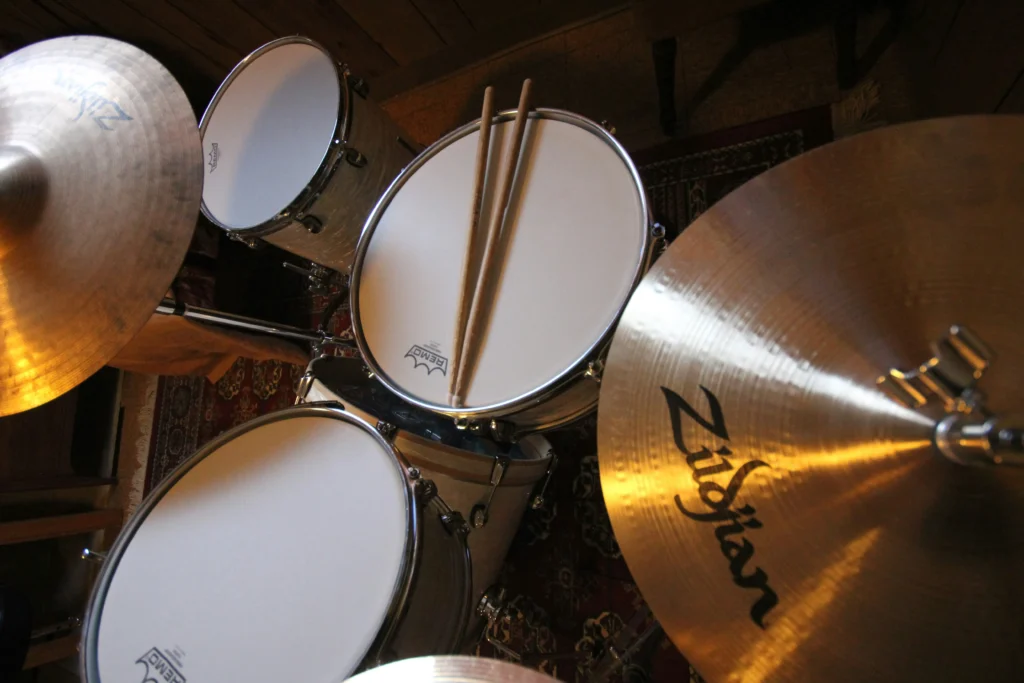
This A complete guide to drum cymbal types and their functions. It is the essential starting point for musicians who want to elevate the sound of their kit to a professional level.
Advertisements
Choosing the right metal is not just a matter of aesthetics, but a technical decision that defines the rhythmic identity and dynamics of each performance.
By 2026, innovations in alloys and hammering processes have expanded tonal possibilities, requiring the modern drummer to understand the nuances between brightness, sustain, and volume.
We will explore the characteristics of each cymbal, the best alloys available on the market, and how each piece contributes to the final musical texture of your band.
What are the most important types of drum cymbals?
To assemble a balanced setup, a drummer first needs to master the three pieces that form the backbone of any musical style, from jazz to extreme heavy metal.
Advertisements
The hi-hat is undoubtedly the most widely used cymbal, serving to mark time with surgical precision, whether played closed, semi-open, or fully open.
Next, we have the Ride cymbal, usually the largest cymbal in the kit, whose function is to maintain the rhythmic pulse with a more constant and defined sound.
The ride cymbal allows for variations between the sound of the bell, which is sharper and more cutting, and the body of the cymbal, which offers a more enveloping "wash".
Finally, the Crash (attack) comes in to accentuate transitions, turns, and finishes, delivering a burst of sound with rapid decay.
One A complete guide to drum cymbal types and their functions. It should always be emphasized that the balance between these three elements defines the clarity of its execution.
How do size and thickness affect timbre?
The physics behind a drum cymbal is fascinating and dictates how it will behave under the drumstick at different stage volumes.
Read more: How to Choose Drumsticks: A Complete Guide
Smaller, thinner cymbals tend to respond faster and with higher pitches, making them ideal for recording in small studios.
Conversely, larger and heavier cymbals require more energy to "open up" the sound, but deliver much higher volume and projection for live performances.
There's something unsettling about how many beginners buy heavy cymbals to play soft styles, resulting in an unbalanced sound.
Thickness also influences the sustainThe more metal there is, the longer the cymbal will vibrate after the initial impact of the drumstick.
Understanding this relationship is crucial to avoid overloading the band's mix with frequencies that are either excessive or insufficient in the show's sound spectrum.
What are effect cymbals and when should you use them?
Beyond the basics, the drummer can add unique textures using Splash, China, and the modern Stacks, which have gained a lot of traction in music productions in 2026.
The Splash is a tiny cymbal that offers a quick and crisp accent, functioning as a subtle punctuation mark in the arrangement.
The China pickup, on the other hand, has inverted edges and a "dirty" and explosive sound, making it very useful in genres that demand an aggressive and short attack.
Many drummers often misinterpret the China cymbal, using it as a ride cymbal, which can oversaturate the sound and tire the ears.
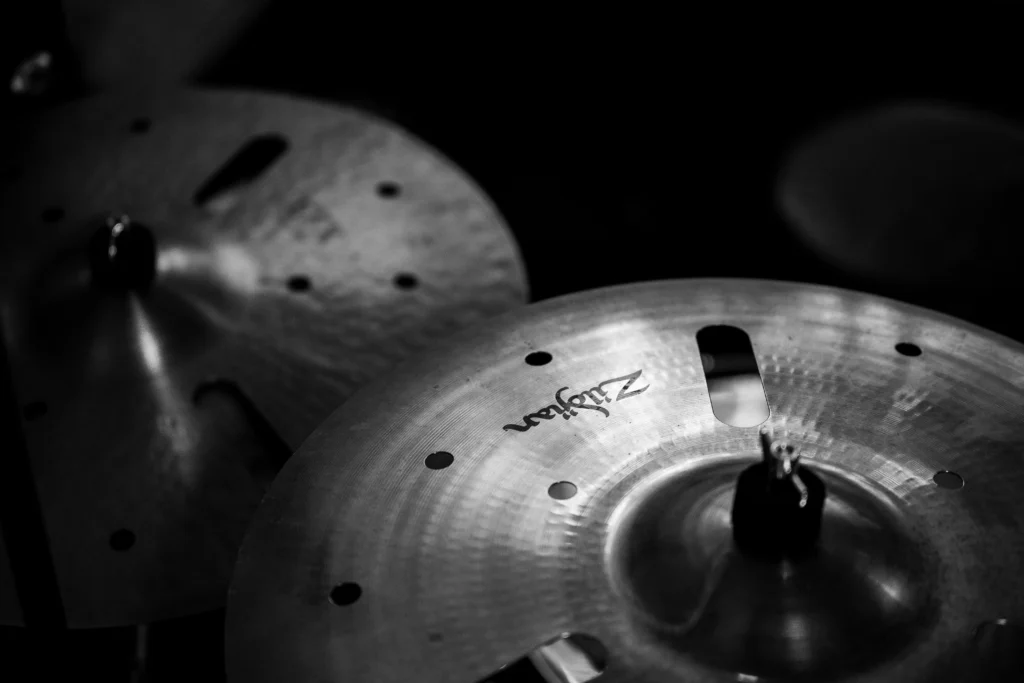
Stacks, which consist of one cymbal mounted directly on top of another, deliver a percussive, dry, and sustain-free sound, very reminiscent of electronic effects.
They are perfect for broken rhythms and modern syncopation, adding a layer of modernity to the traditional acoustic percussion kit.
Learn more: How to choose the first acoustic drum kit for beginners
To fully understand the manufacturing processes and patents that revolutionized these alloys, visit the website of Zildjian Company It offers a technical immersion into hammering and turning.
Knowing the history behind metal helps musicians respect the tool they have in their hands.
Table: Comparison of Metal Alloys (Standard 2026)
| Metal Alloy | Composition (Copper/Tin) | Sound Characteristics | Recommended Use |
| B8 | 92% Copper / 8% Tin | Brilliant, focused, and sharp. | Beginners and trials |
| B10 / B12 | 90-88% Copper / 10-12% Tin | A balance between brightness and warmth. | Intermediate and tours |
| B20 | 80% Copper / 20% Tin | Rich in harmonics, "warm" sound“ | Professional and studio |
| Brass | Copper and Zinc | Limited and dry sound | Basic studies |
| Special Alloys | Secret mixtures and silver | Exotic and personalized tones | Niche setups |
Why is the B20 league considered the elite of cymbals?
B20 alloy is the gold standard in the manufacture of high-performance cymbals due to its malleability and the richness of frequencies it can produce.
Due to its higher tin content, the metal becomes more brittle during manufacturing, requiring complex casting and manual hammering processes.
The result of this productive complexity is a cymbal that "breathes," offering complex harmonics that dynamically adapt to the force of the drummer's touch.
In a A complete guide to drum cymbal types and their functions., B20 is always praised for its musical versatility.
Although the cost is higher, the investment is justified by the durability and tonal quality that does not fade over time.
A well-maintained B20 cymbal tends to mature, becoming even more musical as the metal "settles in" with continued use.
What precautions ensure the longevity of the dishes?
Many drummers lose expensive cymbals due to simple mistakes in setup or attack technique, which is a painful waste of financial resources.
The cymbal should never be too tightly packed on the rack; it needs space to vibrate freely and dissipate the energy of the impact.
Another vital point is the angle of the strike: the drumstick should hit the cymbal with a sideways motion, sliding along the edge, instead of hitting directly “against” the metal.
Head-on impact creates microstructural stresses that invariably lead to the appearance of irreparable cracks in the piece.
Cleaning should only be done with specific products or a dry cloth, avoiding abrasive substances that remove the protective layer (varnish) from the plate.
For detailed guidance on how conservation affects the resale value of percussion instruments, visit the Modern Drummer.
How to choose the right dish for your style?
The final choice should be based on the context in which you play most: a church drummer needs darker, more controlled cymbals, while a rock musician needs projection.
Testing the cymbals in person is essential to feel the physical response and rebound of the drumstick on the metal.
Read more: How to use scales to improvise in different styles.
Always try to listen to the cymbal from a distance, because the sound the drummer hears sitting on the stool is different from the sound that reaches the audience.
Also take into account the durability of the chosen alloy in relation to its volume of performances and constant transport.
Consult this A complete guide to drum cymbal types and their functions. Regularly doing so will help you keep your kit up-to-date and sonically cohesive.
Ultimately, the best dish is the one that inspires you to play more and better, serving as an extension of your rhythmic creativity.
Mastering the fundamentals presented in this guide is what separates a hobbyist from a musician who is aware of their tools of the trade in 2026.
The drum kit is an instrument of nuances, and the cymbals are the "voices" that sing over the weight of the drums.
By investing time in understanding the alloys, sizes, and functions of each component, you ensure that your sound signature is unique and professional.
Don't be afraid to experiment with unusual combinations or mix brands; modern music rewards technical originality.
Treat your dishes with the respect a sculptor dedicates to their tools, and they will respond with the perfect soundtrack for your musical journey.
FAQ: Frequently Asked Questions about Drum Cymbals
Can I mix plates of different alloys in the same kit?
Absolutely. Many professionals mix a B20 Ride with a B12 Crash to obtain contrasting textures that help highlight specific parts of a song.
What should you do when a plate starts to crack at the edge?
Unfortunately, cracks in the edge are often fatal. You can try an "insulation cut," but the original sound structure will be permanently altered. Prevention is still the best approach.
Are shiny dishes always better than matte ones?
No. The glossy finish enhances the treble, while the "raw" or matte finish produces drier, darker sounds, highly valued in jazz and modern hip-hop.
What is the real difference between a cast iron plate and a sheet metal plate?
Cast cymbals are made individually from molten metal, resulting in more unique and richer pieces. Sheet cymbals are cut from sheets of metal, resulting in more uniform and affordable options.
Do left-handed drummers need specific cymbals?
There are no left-handed plates, but the physical arrangement of the stands in the kit should be reversed to facilitate reach and ergonomics during technical execution.
