
Music and child neurodevelopment: what studies say
The relationship between Music and child neurodevelopment It transcends mere entertainment. By 2026, it will be established as an indispensable therapeutic and educational tool, supported by robust evidence of brain plasticity.
Advertisements
Recent studies indicate that structured exposure to rhythms and melodies during early childhood not only entertains, but also accelerates the maturation of cortical areas that are fundamental for auditory processing and executive functions.
What is the impact of music on the child's brain?
The real impact lies in the simultaneous activation of multiple neural networks. Motor, auditory, and emotional areas work together, creating a phenomenon of global "brain training.".
Unlike other activities, music requires the brain to process complex temporal sequences, which strengthens the connections between the left and right hemispheres.
This multisensory stimulation is vital in the early years, when the brain operates at its maximum absorption capacity.
Advertisements
There is something unsettling about how we neglect silence and sound in our environments; after all, the quality of what a child hears today is literally shaping their neural architecture for the future.
How does music help in language acquisition?
Music and speech share a common neural "grammar": the perception of pitch, timbre, and rhythm. It is through this foundation that children learn to segment words and phrases.
Neuroimaging studies show that babies exposed to rhythmic patterns demonstrate greater ease in identifying phonemes, which is an essential predictor for literacy.
This is often misinterpreted as a simple "hobby." In fact, singing to a baby is a highly precise technical stimulus that refines the central auditory system.
Melody acts as a hook for memory, allowing complex verbal communication to be established on already prepared biological terrain.
Why does musical practice improve executive functions?
Learning to play an instrument requires a rare triad: discipline, inhibitory control, and working memory.
These skills, once developed in a musical context, end up spilling over into other areas, such as mathematical reasoning.
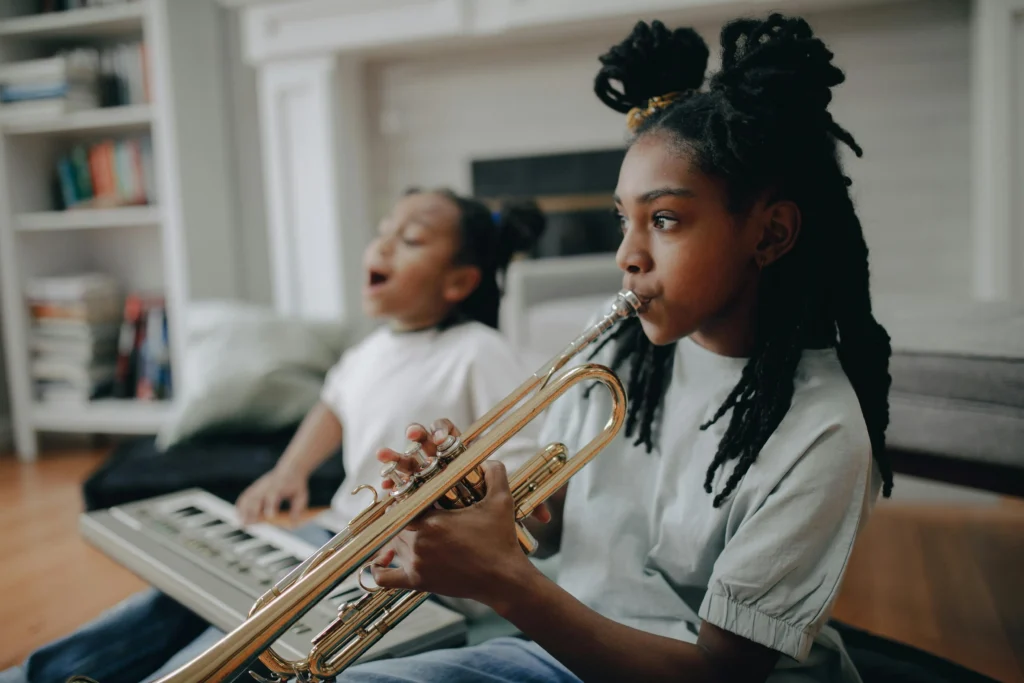
The effort of coordinating fine motor movements with reading symbols and active listening is an unparalleled exercise in focus.
Read more: The Best Musical Toys That Actually Develop Coordination
Constant contact with Music and child neurodevelopment It stimulates the prefrontal cortex, the command center responsible for planning and decision-making.
Children who participate in group activities, such as choirs, develop an ability to monitor their own performance, making them more resilient and attentive in various social situations.
Musical Stimulation and Neurodevelopmental Milestones (2026)
| Age Range | Type of Stimulus | Focused Brain Area | Observed Benefit |
| 0 to 2 years | Songs and lullabies | Limbic System | Emotional regulation and attachment |
| 2 to 4 years | Body percussion | Motor Cortex | Coordination and rhythmic awareness |
| 4 to 6 years | Instrumental initiation | Corpus Callosum | Integration between hemispheres |
| 6 years + | Theory and practice in groups | Prefrontal Cortex | Focus, logical reasoning, and memory. |
What are the effects of music on social skills?
Music, in its essence, is a collective act that demands empathy and absolute synchronicity.
Playing music together reduces cortisol levels and increases the release of oxytocin, creating bonds of belonging that words alone often cannot achieve.
It is a form of applied emotional intelligence that protects the child from isolation.
To experience Music and child neurodevelopment It teaches respect for other people's time. In an orchestra or classroom, a classmate's silence is as important as your own note.
Learn more: How to identify early musical talent in young children.
This social awareness is one of the strongest pillars for long-term mental health, preparing the individual for richer and more balanced human interactions.
For a more in-depth technical explanation of the neurological basis of hearing, please consult the portal of Albert Einstein Israelite Institute for Education and Research, a leading figure in neuroscience in Brazil.
How can music be implemented into the school routine in a technical way?
Modern musical neuroeducation suggests that music should not be an isolated discipline, but a connecting thread that runs through areas such as physics and literature.
Using rhythms to teach fractions, for example, takes advantage of the brain's ability to encode repetitive sound patterns, making learning almost instinctive.
Bringing music into the classroom requires teachers who understand the biological milestones of each age.
Read more: Children's music education without screens: modern methods for 2026
The goal is not necessarily to create virtuosos, but to use sound art as a scaffolding for holistic development.
When schools understand this, they stop seeing music as a luxury and begin to treat it as a fundamental biological right.
What are the risks of inappropriate sound overstimulation?
Noise-saturated environments or loud music can cause sensory fatigue and impair selective attention.
It is vital to distinguish between structured music, which invites listening, and the "background noise" of screens, which can confuse auditory processing and increase chronic stress on the developing nervous system.
Silence is the space where music gains meaning; it is essential for memory consolidation and neural rest.
Parents and educators need to rebalance children's sound diet, prioritizing a diversity of timbres and acoustic instruments instead of incessant exposure to synthetic and repetitive sounds.
When do the benefits of music become permanent?
Neuroscience demonstrates that structural gains, such as increased gray matter volume in motor areas, persist into adulthood.
Even if a child stops practicing an instrument in adolescence, the neural connections established during this critical period of development function as a valuable cognitive reserve.

Invest in Music and child neurodevelopment It's about ensuring a more resilient brain to meet the demands of the future.
Music broadens the mind's horizons from the first stimulus heard in the womb, shaping more sensitive and cognitively capable human beings.
To monitor global research on cognition, we recommend the portal of World Health Organization (WHO).
FAQ: Frequently Asked Questions
1. Is there an ideal instrument to start with?
Simple percussion instruments or flutes are great for early coordination. The key, however, is to respect the child's spontaneous interest and the ergonomics of their body.
2. Does listening to classical music increase IQ?
The so-called "Mozart Effect" has been greatly exaggerated. The real and lasting benefit comes from active practice—playing, singing, and creating—and not just passively listening to music as if it were a magic pill.
3. Does music help children with neurodevelopmental disorders?
Yes, music therapy is a powerful ally for children with ASD or ADHD. It helps with sensory regulation, nonverbal communication, and significantly improves attention and social interaction.
4. Can babies use headphones?
It is not recommended. A baby's ear canal is extremely sensitive; ideally, music should fill the room naturally, at a controlled volume, preserving the integrity of their hearing.
5. What is the ideal frequency of musical stimulation?
Short, playful sessions of 20 to 30 minutes, a few times a week, are much more effective for neurodevelopment than a single long lesson that results in fatigue or boredom.
