
Review of portable speakers for rehearsals.
This Review of portable speakers It was designed for musicians who are tired of lugging around heavy amplifiers for quick rehearsals, but still want a decent tone.
Advertisements
By 2026, portable audio technology will finally have crossed the boundary between "leisure gadget" and serious work tool.
Now, it's perfectly possible to rehearse vocals, guitar, or wind instruments anywhere, with a clarity that, just a few years ago, would have required a full PA system and several nearby power outlets.
The big question is that the choice of equipment determines whether your afternoon of rehearsal will be a productive session or just a losing battle against "cracked" and undefined sound.
We're not talking about boxes to liven up barbecues, but tools that respect the dynamics of your instrument.
Advertisements
Understanding the technical specifications, therefore, ceases to be bureaucracy and becomes a necessity for those who don't want to waste money on low-fidelity drivers.
What defines a truly portable speaker for rehearsals?
An ideal speaker for rehearsals needs, above all, sonic honesty. This means a flat frequency response, without the "flaw" found in commercial models that exaggerate the bass to sound more powerful than they are.
If the speaker masks the mid-range frequencies, you lose the detail of the voice or the attack of the strings, which makes identifying errors virtually impossible.
Furthermore, robustness is non-negotiable; the equipment needs to withstand the rigors of frequent trips without looking like it's going to fall apart.
In 2026, this Review of portable speakers It highlights an interesting change: the death of complex menus in favor of equalization applications.
Being able to adjust the sound curve via your cell phone while listening to the instrument from a distance makes it much easier to adapt to the often poor acoustics of improvised rooms or garages.
The focus has shifted from the number of buttons to the intelligence of signal processing.
How does RMS power dictate the pace of your rehearsal?
Forget the astronomical "Peak Power" numbers printed on the boxes; what keeps the sound clean while you sing is the RMS power.
For a voice and guitar rehearsal, something between 40W and 60W RMS is usually more than enough. If you're in an open environment, however, you'll need at least 100W to avoid being drowned out by street noise.
The secret here is not to play at maximum volume, but to have "reserve" so that the peaks of the music don't distort.
When you push a small amplifier to its limit, the sound loses its dynamics and becomes a tiring mass of sound for the ears.
Ideally, your equipment should operate comfortably at around 70% of its capacity.
For those who like to understand in depth how sound pressure behaves in different spaces, the portal of Audio Engineering Society (AES) It remains the technical bible for avoiding choices based solely on marketing.
Why is sound dispersion the secret to cohesive groups?
Often, the musician facing the speaker hears everything perfectly, while the person next to them receives only a muffled sound. This is where sound dispersion comes in.
Speakers with wide coverage, around 120 degrees, ensure that the entire group hears the same clarity, which is vital for rhythmic harmony.
Without this, the essay becomes a mess of mismatched volumes where nobody understands each other.
In this Review of portable speakers, We've noticed that the vertical array design, that column of small speakers, has gained a lot of ground.
This architecture projects sound in a linear fashion, preventing the volume from dropping drastically as you move away.
It's a technology inherited from large-scale shows that finally fits in the palm of your hand, transforming the perception of space in collective rehearsals.
Which models are truly worth the investment in 2026?
The market is polarized. On one side, we have giants like Bose and JBL offering total versatility with the S1 Pro+ and the PartyBox Stage 320, featuring XLR and 1/4" (P10) inputs that eliminate the need for mixing consoles.
They are veritable "Swiss Army knives" for the modern musician. On the other hand, brands like Mackie and Soundcore focus on impressive energy efficiency, delivering very high volumes with a weight that won't strain your back during transport.
Learn more: How to set up a simple music study setup with technology
THE Review of portable speakers This shows that the choice is almost a matter of aesthetic and functional positioning.
If you're looking for the classic tone of a guitar amplifier, Marshall's Bluetooth 5.4 options deliver that harmonic coloration that pleases even the most traditional ears.
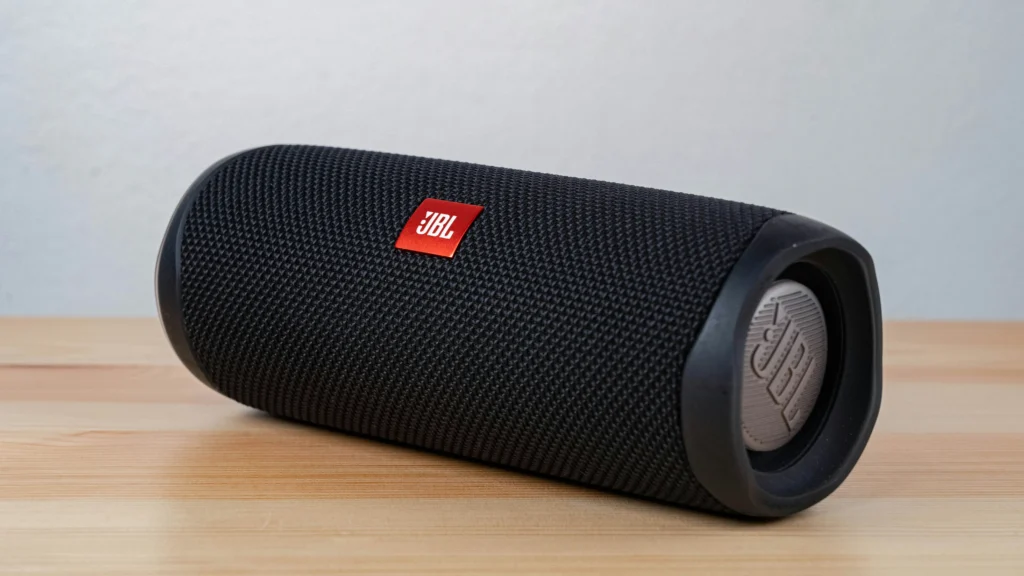
For those who make electronic music or need deep bass to trigger samples, the kevlar cones and passive radiators of the 2026 professional lines are unbeatable.
The State of the Art in 2026
| Model | RMS Power | Real Autonomy | Weight | Emphasis |
| Bose S1 Pro+ | 150W | ~11 hours | 6.5 kg | Fidelity and XLR inputs |
| JBL PartyBox 320 | 240W | ~6 PM | 16.5 kg | Gross sound pressure |
| Marshall Tufton | 80W | ~20 hours | 4.9 kg | Aesthetics and defined averages |
| Mackie Thump GO | 200W | ~12 hours | 8.0 kg | Advanced DSP via App |
| Soundcore Boom 2 | 80W | ~24 hours | 1.7 kg | Extreme portability |
The Bluetooth dilemma: when is the cable still king?
Even though Bluetooth 5.4 is stable, for serious testing, a P10 or XLR cable is still unattainable.
There is a latency, a millimetric delay, that may not bother those listening to music on Spotify, but it can be distracting for any musician who needs rhythmic precision.
Furthermore, wireless signal compression ends up "flattening" the harmonic nuances, taking away the brilliance of that guitar with new strings.
Read more: Review of monitor speakers for home studios.
Ideally, use the physical connection for your main performance and leave Bluetooth only for the metronome or the backing track you'll be using.
On the website of Sennheiser, There are excellent tutorials on how signal integrity changes when we eliminate wireless bottlenecks. It's the difference between sound that just "comes out" and sound that "breathes.".
How do you avoid your drum kit failing you mid-set?
Lithium-ion batteries are like living beings: they hate extremes. Letting the battery drain completely or forgetting it in the trunk of your car under the midday sun is the quickest way to shorten the component's lifespan.
Ideally, the charge should always be kept between 20% and 80%. By 2026, smart charging pads will already be very helpful, but user care will still be the determining factor for the longevity of the investment.
This Review of portable speakers It suggests that you avoid using the power saving mode during high-volume tests.
Read more: We tested the Odery Custom Drum Box – Premium Sound and Aesthetics
This mode usually limits the current going to the amplifier, which flattens the sound dynamics and makes the speaker sound "tired".
Keeping the firmware updated is also crucial, as manufacturers often release patches that optimize power consumption as the battery ages.
Frequently Asked Questions (FAQ)
Can I plug my bass directly into these speakers?
You can do it, but be careful with the volume. Bass frequencies require a lot of air displacement and can damage drivers that weren't designed for such sub-bass frequencies at high volumes.
What is Auracast, which comes with some new boxes?
It's a technology that allows you to connect dozens of speakers simultaneously without cables. Useful if you want to spread the sound of your rehearsal across multiple rooms at the same time.
Do I need a stereo speaker to rehearse alone?
Not necessarily. For instrument monitoring, mono sound is usually more focused and avoids phase cancellations that occur in rooms with poor acoustics.
What is the real difference between an R$ 500 box and an R$ 3000 box?
Components. Neodymium magnets, smarter digital signal processors (DSPs), and drivers that don't distort when pushed. It's the difference between hearing the sound and feeling the instrument.
Choosing a portable speaker is ultimately about deciding how you want to be heard. The current market offers options for all tastes, but fidelity should always be your guiding principle.
Protect your equipment, understand its limitations, and prioritize the purity of the tone over any colored LED light.
For those who want even more objective metrics and lab tests, it's worth checking out... RTINGS, which remains the gold standard for straightforward hardware reviews.
Ultimately, the best review is what your ear hears after two hours of productive rehearsal.
