
Comparison: Analog vs. Digital Distortion Pedals
The debate about Analog vs. Digital Distortion Pedals In 2026, it reached a level of technological sophistication that challenges even the most trained ears of experienced producers and guitarists in the music industry.
Advertisements
While purists defend the organic response of physical components, technology enthusiasts celebrate the sheer versatility and surgical precision of new digital signal processing algorithms.
In this guide, we will explore the technical nuances that define each architecture, analyzing how the behavior of harmonics and the dynamics of touch influence your final choice.
We will investigate the resurgence of boutique circuits and the consolidation of high-fidelity modelers who currently dominate the professional scene.
What are the main differences between analog and digital circuits?
At its core, an analog pedal uses physical components such as diodes, transistors, and capacitors to manipulate the guitar's electrical waveform in a continuous and direct manner.
Advertisements
This distortion occurs through physical "clipping," resulting in a natural compression that many musicians describe as warm, rich in odd harmonics, and extremely responsive.
On the other hand, digital processing converts the electrical signal into binary data, applying mathematical calculations to simulate the distortion behavior before converting it back into audio.
By 2026, latency will have become imperceptible, allowing modeling algorithms to capture subtle nuances of classical amplifiers with near-perfect accuracy.
There's something unsettling about how quickly the digital world has evolved, and this is often misinterpreted as a threat to tradition.
In fact, the coexistence of Analog vs. Digital Distortion Pedals It offers the contemporary musician an unprecedented palette of timbres, uniting the past with the future.
How does dynamic response influence live performance?
Dynamics refers to the pedal's ability to react to the guitar's volume and picking force, an area where analog pedals have historically held a considerable competitive advantage.
A good analog "drive" pedal cleans up the sound almost completely when you lower the instrument's volume potentiometer.
However, modern digital signal processors (DSPs) use machine learning to replicate this response curve with impressive fidelity, eliminating the old feeling of static compression.
This allows stage guitarists to have hundreds of gain variations under the control of a single expression pedal.
To understand the technical specifications for conversion and the ideal sampling frequency for high-resolution audio, visit the website of Audio Engineering Society (AES) It offers in-depth academic resources on modern signal processing in 2026.
Technical Comparison of Distortion (2026)
| Feature | Analog Pedal | Digital Pedal (Modeling) |
| Processing | Continuous (Physical components) | Discrete (DSP Algorithms) |
| Variety | A specific basic timbre | Multiple templates and presets |
| Energy Consumption | Low (Usually 9V standard) | High (Requires robust power supplies) |
| Interface | Individual physical buttons | LCD screens or Bluetooth connection |
| Background Noise | It may be subject to RFI interference. | It usually has a digital "gate". |
| Average Price | R$ 600 – R$ 3,000 (Boutique) | R$ 1,200 – R$ 5,500 (High-end) |
Why are analog pedals still the favorites in studios?
The preference for physical circuits in a recording environment lies in the unique texture that real hardware imparts to the audio, which is often difficult to fully replicate in post-production.
The harmonics generated by an analog distortion pedal possess an organic randomness that lends depth and presence to the final mix.
Read more: Is it worth buying a pedal board or separate pedals?
Sound engineers often seek out the asymmetrical "clipping" of germanium diodes to add a vintage character that cuts through the mix without sounding harsh to the ears.
This physical saturation interacts with microphone preamps in a way that digital plugins are still trying to emulate with varying degrees of success.
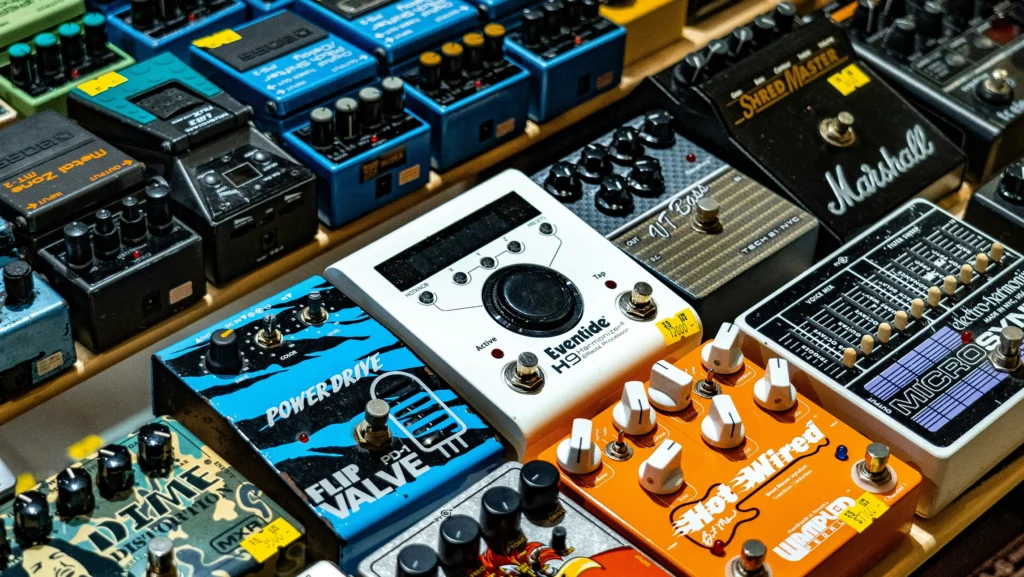
When comparing Analog vs. Digital Distortion Pedals, We noticed that the analog interface encourages happy mistakes and immediate tactile exploration, without complicated menus.
This operational simplicity helps maintain the artist's creative focus, avoiding the paralysis of choice that an excess of digital options can cause.
Which digital technology will lead the guitar market in 2026?
Currently, the market is dominated by neural network capture, where the pedal "learns" the behavior of a real analog amplifier or pedal through artificial intelligence.
Learn more: The most iconic guitar solos in Brazilian guitar and how to study them.
This allowed compact units to offer the sound of rare equipment costing tens of thousands of dollars in a portable format.
These digital units also offer full integration with impulse response (IR) chargers, simulating not only the distortion, but also the cabinet and microphone used.
For musicians who travel constantly, the weight savings and sound consistency across different PA systems are unbeatable.
We observe that the modern professional rarely chooses only one side of the coin, preferring hybrid systems where the initial "gain stage" is analog and the modulations are digital.
This approach combines the immediate "punch" of the physical component with the spatial flexibility and precision of advanced computational processing.
What are the durability and maintenance implications between them?
Maintaining an analog pedal is generally simpler and cheaper, as any qualified technician can replace a worn potentiometer or a blown capacitor.
Classic circuits from the 70s and 80s continue to function perfectly today, which attests to their historical resilience and resale value.
Learn more: Best looping pedals for acoustic guitar
Digital devices, on the other hand, function like dedicated computers and, although they are robust against physical drops, they can suffer from software obsolescence or failures in proprietary integrated components.
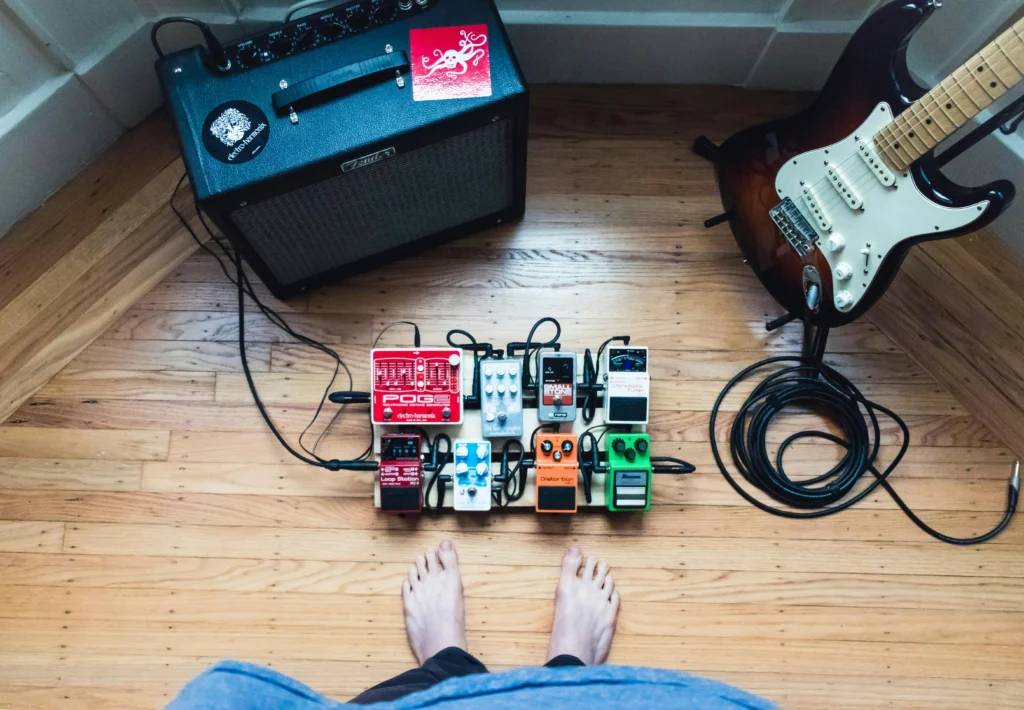
The lifespan of a digital pedal is often dictated by brand support and the firmware updates available on the market.
When deciding between Analog vs. Digital Distortion Pedals, Consider that analog is a lifelong investment, while digital is a high-performance tool for the present.
Both have their place, depending on whether you prioritize historical value or cutting-edge technological efficiency.
To explore the latest trends in hardware design and innovations in audio synthesis, the portal Sound on Sound It offers detailed analyses of professional audio equipment and cutting-edge recording techniques.
FAQ: Common Questions about Distortion Pedals
Do digital pedals have noticeable latency when playing?
In 2026, the latency in high-quality pedals is less than 2 milliseconds, which is imperceptible to humans. However, in extremely cheap or poorly designed units, the delay can bother musicians who have a very precise pick attack.
Can I mix analog and digital pedals on the same pedalboard?
Yes, and that's the most common practice nowadays. It's recommended to place analog distortions at the beginning of the chain to preserve interaction with the pickups, and use digital distortions for ambience, delays, and cabinet emulations at the end of the signal.
Is digital timbre really "cold" compared to analog?
This concept became a myth with the advancement of high-resolution modeling. What was once called "cold sound" was actually a lack of harmonic resolution, something that modern 32- or 64-bit processors solved with advanced oversampling algorithms.
The choice between Analog vs. Digital Distortion Pedals It should not be seen as a competition of superiority, but as a selection based on specific workflow needs.
If you're looking for classic warmth and the simplicity of a circuit that reacts to every nuance of your touch, analog remains the gold standard.
On the other hand, if your routine demands extreme versatility, consistency across different stages, and hundreds of sounds in one place, then digital is the ultimate solution.
The musician of 2026 is one who uses technology to serve their art, extracting the best from each architecture to create innovative sounds.
Ultimately, the best pedal is the one that inspires you to play more and explore new musical frontiers. The ideal balance lies in experimentation, as the ear is the only sovereign judge in any search for tone.
