
How to adjust your ideal mouthpiece for optimal performance.
For many wind instrument musicians, the quest for the perfect tone seems like an endless journey, but learning to... Adjust your mouthpiece for optimal performance. It's the dividing line between effort and fluidity.
Advertisements
By 2026, materials technology and acoustic design have advanced, allowing instrumentalists to achieve previously unimaginable levels of sonic precision with millimeter-precise adjustments and conscious choices of accessories.
In this article, we will explore the technical secrets that transform the experience of playing the saxophone, clarinet, or other wind instruments.
We will discuss the physics behind mouthpiece opening, the importance of reed alignment, and how ligature pressure directly influences sound projection and dynamic control.
What defines the opening of a mouthpiece and how does it affect the sound?
The mouthpiece opening is the distance between the tip of the reed and the tip of the mouthpiece itself, a critical factor for air resistance.
Advertisements
Mouthpieces with larger openings require softer reeds, providing a more robust sound and flexibility for effects. bending and expressive vibrato.
Conversely, smaller apertures offer greater control and ease of sound production, making them preferred by classical musicians seeking a focused and pure sound.
The balance between the openness and hardness of the reed is the secret to achieving... Adjust your mouthpiece for optimal performance. without compromising the overall tuning of the instrument.
Professional musicians in 2026 will use spectral analysis software to understand how the inner chamber, the empty space inside the mouthpiece, shapes the harmonics.
A small, tall chamber tends to enhance brightness, while large, round chambers evoke the classic, velvety sound of traditional jazz.
How does the positioning of the ligature alter the response of low and high notes?
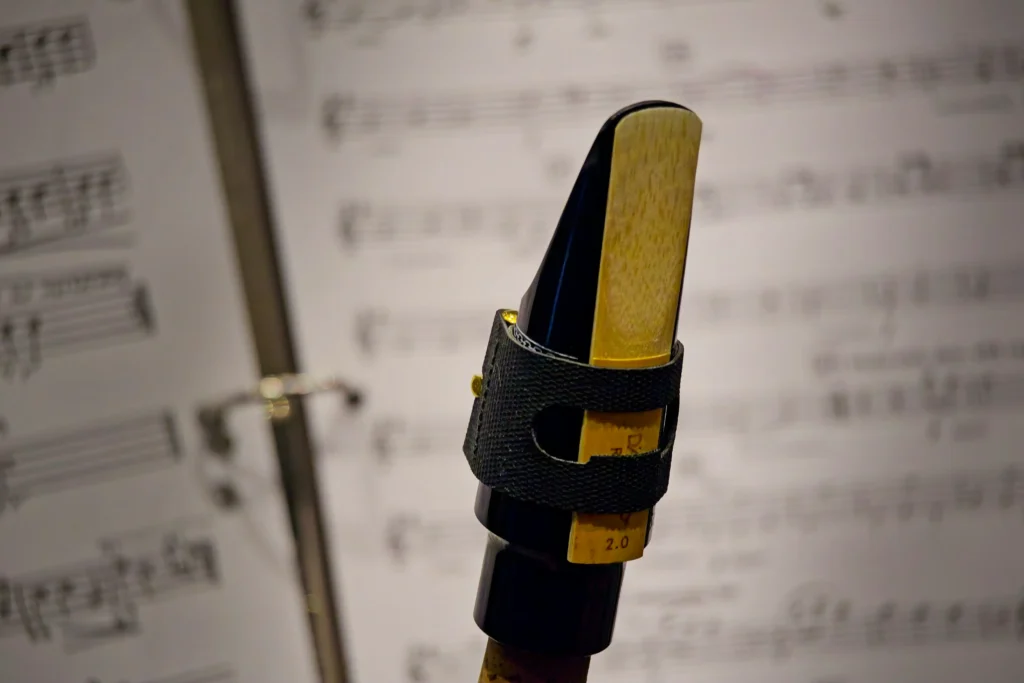
Many instrumentalists underestimate the impact of the ligature, but it is responsible for allowing the reed to vibrate freely or with controlled restraint.
Positioning the ligature closer to the tip increases resistance, which can help stabilize extremely high notes, known as super-high notes.
Learn more: A practical guide to listening to music for children, according to experts.
By moving the clamp slightly backward, towards the base of the reed, you allow a larger area of the material to vibrate freely.
This generally results in an easier response in the lower notes, making the articulation more "crisp" and facilitating the execution of fast technical passages in lower registers.
There are contemporary models of cable ties made of carbon fiber or cryogenic metal alloys that promise superior sound conduction compared to those made of synthetic leather.
To better understand the science of materials applied to music, the portal of Vandoren Paris It offers detailed studies on how the density of accessories influences acoustics.
Technical Parameters of Mouthpieces and Sound Response
| Feature | Impact on Performance | Recommended for: | Difficulty in Control |
| Wide Opening | Greater volume and sound projection. | Jazz, Rock and Pop | High |
| Narrow Opening | Precision in tuning and focus. | Scholars and beginners | Low |
| Small Chamber | Bright and sharp timbre. | Soloists in bands | Average |
| Big Chamber | Dark and full-bodied timbre. | Orchestra and Quartets | Low |
| High Baffle | Drastic increase in volume. | Noisy environments | Very High |
Why does double or triple articulation depend on the fine adjustment of the mouthpiece?
Articulation technique requires an instantaneous response from the reed to the touch of the tongue, which is impossible if there are air leaks.
You should Adjust your mouthpiece for optimal performance. ensuring that the base of the reed is perfectly flat against the mouthpiece to avoid unwanted hissing.
Learn more: Best exercises for double and triple articulation in wind instruments.
In 2026, exercises of voicing — the use of the throat and tongue to shape the sound — are integrated into the adjustment of the physical equipment.
If the mouthpiece is too closed, the reed may "jam" during rapid attacks; if it is too open, the musician tires before completing long staccato phrases.
The use of mouthguards (compensators) of different thicknesses also alters the angle of air entry, directly impacting embouchure comfort.
A millimeter-precise adjustment in the position of the upper teeth can release tension in the jaw, allowing the tongue to move with the agility necessary for technical virtuosity.
What are the signs that your mouthpiece needs maintenance or replacement?
Even mouthpieces made of ebonite or high-quality metal suffer wear and tear over time due to the acidity of saliva and constant contact.
If you notice that the instrument is losing its tuning in specific octaves or if the reed no longer seems to seal, examine the side rails carefully.
Asymmetrical or worn rails prevent the reed from vibrating evenly, resulting in a dull, lifeless sound that frustrates any dedicated musician.
Read more: Difference in sound between an open and closed mouthpiece.
Regular cleaning with warm water and mild soap is essential to prevent calcium buildup, which alters the original internal dimensions of the acoustic design.
Many musicians resort to "refacing," a handcrafted process of sanding the rails and table to restore or customize the mouthpiece's curve.
Consult websites of renowned experts such as Theo Wanne It helps you understand when to invest in a restoration or when it's time to buy a new model.
FAQ: Frequently asked questions about mouthpiece adjustments
Does the mouthpiece material (metal vs. clay) really change the sound?
Although many argue that metal sounds brighter and solid metal darker, physics suggests that internal dimensions are more important. The material has a greater influence on the sensation of vibration that the musician feels in their teeth and the weight of the mouthpiece than on the timbre projected to the audience.
How can you tell if the reed is perfectly aligned?
The reed should be centered, and its tip should align exactly with the tip of the mouthpiece, or be a hair's breadth below. A crooked alignment causes uneven resistance in the rails, making it difficult to control the tuning and resulting in inconsistent sound between notes.
Can I use the same mouthpiece for different musical styles?
It's possible, but it requires significant adjustments to the reed and embouchure technique, which isn't always ideal for professional performance. Having a specific mouthpiece for jazz and another for classical music ensures you have the optimized setup for the aesthetic demands of each genre.
Mastering the art of choosing and setting up your equipment is a fundamental step for any instrumentalist who wants to stand out in the contemporary music scene.
When learning to Adjust your mouthpiece for optimal performance., By doing so, you remove the technical barriers between your artistic intention and the sound that echoes from your instrument.
Remember that the equipment should serve the musician, providing the necessary comfort so that emotional expression can flow without resistance.
Try different combinations, listen critically to your recordings, and don't be afraid to make small adjustments until you find the perfect balance.
The technological evolution of 2026 is in your favor, offering tools that make the sonic journey richer and more rewarding.
His unique voice on the instrument depends on this meticulous attention to every detail, from the tip of the reed to the base of the sound chamber.
With patience and technical study, your performance will reach new levels of excellence and acoustic brilliance.
