
How to Get a Driver's License: The Complete Step-by-Step Guide from Zero to Approval
How to Get a Driver's License: The Complete Step-by-Step Guide from Zero to Approval This is a very common question for those who are starting to drive and look at the whole process without knowing exactly where to begin.
Advertisements
Among documents, DMV, theoretical test, learner's permit In practical terms, it really seems like there's too much to figure out. However, when you break everything down into steps, it becomes much simpler.
First and foremost, there is a very important detail: There is no single licensing process that is exactly the same for all of the United States..
A driver's license is issued by the states, so age requirements, documents, fees, practice period, and some rules may change depending on where you live.
USAGov itself advises applicants to consult their state's motor vehicle agency to verify current requirements. Even so, the process usually follows a fairly similar logic.
Advertisements
You check your eligibility, gather the documents, submit the application, study the traffic laws, go through the process. knowledge test, obtains permission to practice when applicable and subsequently performs the behind-the-wheel test, That is, the driving test. That's exactly the path we're going to explain here.
Furthermore, there are free resources that greatly facilitate preparation. Official manuals, practice tests, materials on road signs, and even study apps can help.
So, if you're literally starting from scratch, there's no need to feel lost. The idea is to advance one step at a time and always check the specific rules of your state before scheduling any exam.
Start with your state's DMV.
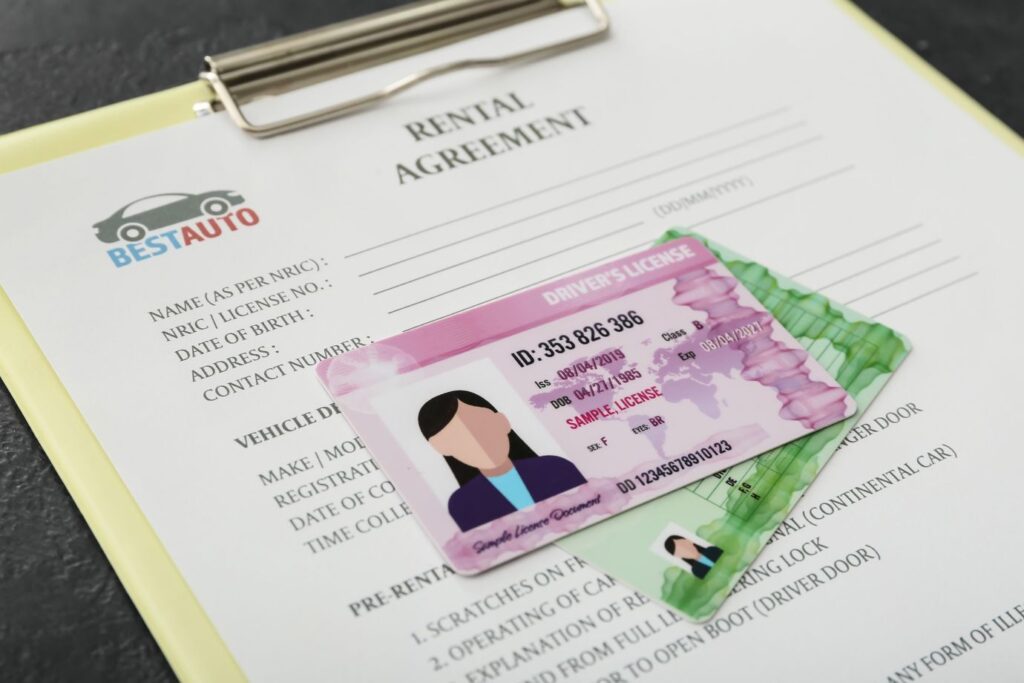
The first place you need to visit is the DMV or equivalent agency in the state where you live..
Depending on the state, the responsible agency may have a different name, but its function is similar: to handle services related to driver's licenses, identification, vehicles, and registrations. This is the agency where you will find the official information to begin your application.
This step is important precisely because the requirements are not national. For example, accepted documents, fees charged, and rules for underage candidates may differ.
Therefore, avoid relying solely on old videos or tips from acquaintances. Use this information as a supplement, but... Confirm everything on your state's official website. before we begin.
A simple way to find the correct agency is to use the official USAGov directory. It compiles the motor vehicle services of the American states and territories, allowing you to find the agency responsible for the region where you live.
How to get started:
- Access the official directory of state services;
- Choose the state where you live;
- Look for the section of Driver's License;
- See the requirements for First-Time Driver or equivalent;
- Check the required documents, fees, and scheduling requirements;
- Only after that should you begin your application.
You will be redirected to the official government directory to choose your state.
Gather all the necessary documents.
After discovering exactly which agency serves your state, it's time for the part that usually generates the most questions: the documents.
Although the list varies depending on the state and the type of driver's license requested, you will usually need to present documents related to your identity and residence.
Depending on the situation, there may also be requirements related to the Social Security Number.
In California, for example, the DMV reports that applicants for a instruction permit or Driver's License must present proof of identity and proof of residence, In addition to complying with the rules related to legal name and Social Security Number, when applicable.
This serves as a good example of why it's so important to check your state's specific list.
Another important point is deciding whether you want to apply for one. REAL ID-compliant Driver's License. REAL ID adheres to additional federal security standards.
According to USAGov, the documents typically requested in this process include proof of identity, Social Security Number, and residency, but the final list is determined by the state.
Basic checklist for getting organized:
- Check the official list for your state;
- Separate the accepted forms of identification;
- Gather the required proof of residence documents;
- Check the rules related to the SSN;
- Check if you want a REAL ID;
- Check if original documents or certified copies are required;
- Organize everything before going to the appointment.
Study using the official Driver Handbook.
Now begins one of the most important stages of How to Get a Driver's License: The Complete Step-by-Step Guide from Zero to Approval: to study.
Each state provides its own Driver's Handbook, which basically functions as the official manual for learning traffic laws, signage, safe driving, and other information required for the test.
It's no use trying to just memorize answers from practice tests. The best approach is to understand the rules first and then use the tests to discover where you're still making mistakes.
The California DMV, for example, recommends reviewing the California Driver's Handbook before knowledge test and states that the questions are based on the content of the manual.
You will likely find topics related to signs, speed limits, right-of-way, lane changes, parking, safe following distance, alcohol and driving, pedestrians, and emergency situations.
Some rules are intuitive; others are very specific. That's why it's worth setting aside a few days to study instead of trying to learn everything a few hours before the test.
A simple study routine could be:
- Read a section of the Driver's Handbook;
- Write down the rules that you often get confused;
- Check the traffic signs;
- Ask some test questions;
- Check your mistakes;
- Go back to the manual;
- Repeat until you consistently achieve good results.
Take practice tests before the Knowledge Test.
After studying the manual, the practice tests They are probably one of the most useful tools for finding out if you are truly prepared.
They are particularly helpful because they present the content in a question-and-answer format, making studying much more similar to the actual exam experience.
Some DMVs offer their own sample tests for free. The California DMV, for example, provides... Sample Driver's License Knowledge Tests, including various practice tests for the regular Class C portfolio. The agency also periodically updates the sample questions.
However, don't turn the practice test into a competition where you simply memorize answers. When you get a question wrong, find out... why did you make a mistake.
Was it a sign that caused confusion? A right-of-way rule? A distance? It is precisely this error that reveals the topic that needs to be reviewed before the actual test.
To make the most of the practice tests:
- Try it first without consulting the manual;
- Mark the incorrect statements;
- Discover which rule is behind each mistake;
- Review the topic in the Driver's Handbook;
- Try another test;
- Repeat until your results are consistent.
Study using your cell phone too.
In addition to the practice tests available on official websites, you can also use driver's license preparation applications to study directly from your cell phone.
There are options with practice questions, traffic signs, simulated tests, and review of the main rules covered in the exam. Knowledge Test.
To make things easier, look for study apps that are compatible with the state where you plan to get your driver's license, as some rules and requirements may vary.

Pass the Knowledge Test and get your permit.
When you're ready, the time comes to... knowledge test, informally known as a written exam or theoretical exam.
The goal is to check if you are familiar with traffic laws, safety rules, and the information necessary to drive correctly. The format and rules depend on the state.
In California, for example, those applying for a Class C instruction permit must complete the application, submit the necessary documents, pay the corresponding fee, and pass the required tests, including knowledge test and vision test.
After approval, depending on your age and situation, you may receive a instruction permit or learner's permit.
It's essential to understand that a learner's permit doesn't automatically mean you can drive alone. There are restrictions that need to be respected, and these vary by state.
The process typically involves:
- Apply the product;
- Submit the documentation;
- Pay the applicable fee;
- Take the vision test;
- Take the knowledge test;
- To be approved;
- Receive your permission, when applicable;
- Read all the restrictions in the document carefully.
Practice driving before the Road Test.
Did you pass the theory part? Great. Now comes the part that really requires practice. The road test or behind-the-wheel test It serves to demonstrate that you can control the vehicle, follow the rules, and make safe decisions in traffic.
It's no use knowing the entire Driver's Handbook if you've almost never driven. You need to turn theory into habit.
Therefore, practice basic things repeatedly: speed control, use of mirrors, lane changes, turns, stops, intersections, parking, and observing pedestrians and other vehicles.
Practice requirements vary primarily by age and state. In California, for example, applicants under 18 have specific requirements, including a minimum period with the permit and hours of supervised practice. Adult applicants follow different rules.
During training, focus primarily on:
- Complete stops;
- Right and left turns;
- Speed control;
- Proper use of mirrors;
- Change lanes;
- Observing blind spots;
- Parking;
- Input and output of the flow;
- Respect the signs and traffic lights;
- Defensive driving.
Prepare for the Behind-the-Wheel Test
We've reached the moment that usually gives you butterflies in your stomach: the behind-the-wheel test. However, the examiner is not expecting a flawless, professional pilot performance.
The assessment aims to verify if you can operate the vehicle safely, follow the laws, and demonstrate appropriate driving habits.
In California, for example, the test includes a safety check before driving and a practical performance evaluation.
The DMV explains that the goal is to observe whether the candidate can operate the vehicle safely, apply traffic laws in real-life situations, and demonstrate good driving habits.
Therefore, before the day of the test, it's worth practicing in the vehicle you intend to use, when permitted. Familiarity helps a lot.
Find out where the headlights, wipers, parking brake, hazard lights, and other basic controls are located. Also, confirm in advance what documents and requirements the vehicle needs to meet to be accepted for the test.
On the day of the road test:
- Arrive early;
- Bring the required documents;
- Check the vehicle requirements;
- Adjust the seat and mirrors;
- Fasten your seatbelt;
- Listen carefully to the instructions;
- Don't rush when performing maneuvers;
- Pay attention to signs, pedestrians, and traffic;
- Demonstrate safe habits throughout the journey.
From initial registration to your driver's license.
To understand How to Get a Driver's License: The Complete Step-by-Step Guide from Zero to Approval It becomes much easier when you stop viewing the process as one huge test.
In practice, it involves several small steps: discovering the rules of your state, gathering documents, studying, passing the knowledge test, practicing, and finally taking the road test.
Furthermore, there is no reason to study completely in the dark. The state agencies themselves provide... Driver handbooks, educational materials and, in some cases, free practice tests..
California, for example, offers sample tests, additional materials, and specific resources for preparation.
The most important point is not to assume that a rule found for one state automatically applies to another. Minimum age, documents, fees, number of practice hours, permit restrictions, and testing procedures can vary.
Therefore, always use the Use the official website of your state's motor vehicle authority as the final reference.. USAGov maintains a directory specifically for finding these state services.
Finally, try not to view the test merely as something that needs to be "passed." The goal of the entire process is to get you into traffic knowing what you're doing. Drive safely and make good decisions behind the wheel..
Study the manual, take practice tests, practice a lot, and correct your mistakes before the test. That way, when the day of the evaluation arrives, you will be much more prepared to obtain your Driver's License.
