
Discover the sarangi, a traditional Indian bowed instrument.
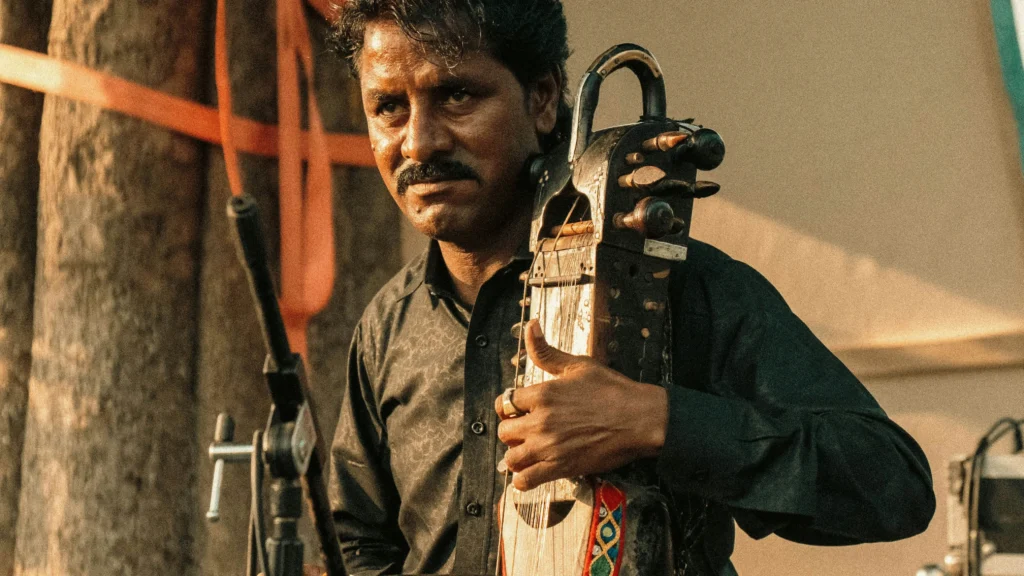
THE sarangi It is widely recognized as the bowed instrument that most closely approximates the complexity of the human voice, occupying a central place in Indian classical music.
Advertisements
Originating from the Indian subcontinent, this carved wooden instrument possesses a melancholic sound rich in harmonics, capable of reproducing the most subtle nuances of singing.
In 2026, global interest in ethnic instruments restored the prestige of this device, which was previously seen almost exclusively as a secondary accompaniment.
In this article, we will explore its unique construction, the demanding technique required to play it, and the vital role it plays in preserving the musical traditions of North India.
If you are a musicology enthusiast or seek to expand your cultural repertoire, understanding this instrument is a fundamental step.
Advertisements
What is sarangi and what is its historical origin?
THE sarangi It is a bowed string instrument carved from a single block of wood, traditionally Indian cedar or tun.
Its robust structure supports a goatskin stretched over the resonance cavity, ensuring a warm and organic sound projection that reverberates in an almost visceral way.
Music historians trace its roots to the folk traditions of the Rajasthan and Punjab regions.
Over time, it migrated to the royal courts of India, becoming the ideal support for singers of khyal and Thumri, thanks to its ability to "cry" along with the melody.
There's something unsettling about how such an expressive instrument nearly faced extinction in the last century.
This is often misinterpreted as technological obsolescence, but it was actually a reflection of social and colonial pressures that marginalized certain traditional sounds in favor of Western aesthetics.
How does the sarangi produce its unique sound?
The sonic magic lies in the system of sympathetic strings that vibrate without ever being directly touched by the bow.
THE sarangi It typically has three main gut strings and up to forty steel strings hidden beneath the bridge.
These secondary strings are tuned according to the notes of the raga (scale) being played. When the musician plays the main strings, the sympathetic strings resonate, creating a persistent natural echo that seems to fill the entire room.
To better understand the acoustic physics involved in Hindustani classical music and the importance of cultural preservation, the portal of Sangeet Natak Akademi It offers a valuable collection of information about instrument maintenance and their unique harmonic properties.
Why is the technique for playing this instrument so difficult?
Unlike the Western violin, the musician does not press the strings with the tips of their fingers; they push them sideways with the base of their fingernails.
THE sarangi requires the hand to constantly slide to create the effect of meand, that fluid connection between the notes.
This continuous glissando connects one note to another, essential for imitating Indian vocal ornaments. The constant friction on the fingernails requires the formation of specific calluses and millimetric precision to maintain correct tuning on a fretless neck.
Mastering this instrument represents one of the greatest intellectual and physical achievements in world music.
Technical difficulty should not be seen as a barrier, but rather as the price to pay for accessing an emotional palette that few other instruments can achieve.
Read more: Tambura: The Indian Instrument That Doesn't Play Melody
Classic Sarangi Specifications
| Component | Predominant Material | Main Function | Sound Impact |
| Body (Kunda) | Tun Wood (Cedar) | Structure and resonance | Dark and deep timbre |
| Top | Goatskin | Vibration transmission | Organic and percussive sound |
| Main Strings | Gut | Melody production | Smooth texture and vocal |
| Sympathetic Cords | Steel and Brass | Harmonic resonance | Aura of echo and support. |
| Bow (Gaj) | Ebony and Horsehair | Rhythmic friction | Dynamics and attack control |
What are the regional variations of sarangi in India?
Although the classic model is the most widespread, there are smaller folk versions used by itinerant musicians in the Rajasthan desert.
THE sarangi Folkloric instruments tend to have fewer sympathetic strings and a more straightforward construction, adapted to nomadic life.
These variations keep the narrative music of the villages alive, recounting legends of local heroes and gods with a rawness that the concert model sometimes softens.
The transition between rustic and classical styles demonstrates the absolute versatility of this instrument.
It is essential to understand that each regional variation carries with it its own musical dialect.
The sound reflects the landscape, the climate, and the struggles of the people who built it with their own hands, acting as a sonic time capsule.
Check it out: Meet the Indian Sitar: Structure, Sound and Influence on Rock
When did the sarangi begin to be recognized as a soloist?
For centuries, the instrument was relegated to the role of a shadow to the singer, merely repeating the melodic phrases performed by the voice.
THE sarangi She only gained prominence as a leading soloist in the 20th century, a late artistic liberation movement.
Legendary masters like Pandit Ram Narayan struggled to prove that the instrument possessed enough virtuosity to sustain entire concerts on its own.
This paradigm shift raised not only the prestige of music, but also the social status of the instrumentalists themselves.
Learn more: What is santoor and how is it played in India?
Today, in 2026, we are witnessing a modern integration with contemporary genres, including jazz and ambient.
The ability to adapt without losing its spiritual essence is what guarantees its relevance on global stages.
How to care for and maintain an authentic sarangi?
Maintenance is rigorous due to the sensitivity of the organic leather and wood to temperature changes.
THE sarangi It must be kept in controlled environments to prevent the single block of wood from suffering irreparable cracks.
Changing gut strings requires patience; the natural material constantly reacts to moisture and the heat from the musician's hands.
Furthermore, applying high-quality rosin to the bow is essential to ensure proper grip.
For those who wish to acquire or study in depth the conservation of oriental instruments, the The Metropolitan Museum of Art It has a section dedicated to musical instruments with technical guides for their conservation.
Owning one of these pieces requires dedication and a deep respect for artisanal tradition, treating each piece as a living organism.
The future of this tone depends on the new generation of musicians who accept the challenge of mastering its strings.
FAQ: Frequently Asked Questions about Sarangi
What is the practical difference between a sarangi and a violin?
The main difference is the fingering technique (using the fingernails) and the dozens of sympathetic strings that the violin does not have. The timbre of the Indian instrument is much denser and more "vocal" than that of the Western violin.
Is it possible to learn to play an instrument on your own?
Given the complexity of tuning and fingerpicking techniques, having a master (guru) is essential. However, modern online courses now make it easier to understand the theory of ragas before even getting to the physical contact with the instrument.
How much will a professional instrument cost in 2026?
A high-quality sarangi, made by renowned luthiers in India, ranges in price from $800 to $2,500. The price usually depends on the age of the tun wood and the precision of the sympathetic string tuning.
Why is the instrument called "hundred colors"?
The name derives from the Hindi words “sau” (hundred) and “rang” (colors). This describes its ability to produce a myriad of sonic nuances, adapting to whatever mood or feeling the music demands.
Is "sarangi" used in modern genres?
Yes. Although its basis is Hindustani classical music, it is widely used in Bollywood soundtracks and electronic fusions, bringing an emotional charge that synthesizers can hardly replicate with the same soul.
