
What makes the Latvian kokle unique among European zithers?
The study about Latvian kokle It reveals how a traditional plucked string instrument stands out in the organological landscape of Northern Europe due to its unique construction and cultural role.
Advertisements
Belonging to the family of hollow-bodied zithers, this Baltic instrument shares kinship with the Finnish kantele, the Estonian kannel, and the Lithuanian kankles, while retaining unique characteristics.
Understanding the acoustic and symbolic particularities of this chordophone allows us to appreciate the value of heritage preservation in Latvia and the evolution of its musical notation on contemporary concert stages.
Analyzing the anatomy, the method of execution, and the symbolism carved into the wood helps to understand why this acoustic icon continues to fascinate ethnomusicologists and instrumentalists globally.
What is kokle and what are its historical origins?
This musical instrument belongs to the family of hollowed-out zithers, traditionally constructed from a single block of carefully worked linden, pine, or birch wood.
Advertisements
The top of the hollow body is covered by a thin, resinous wood soundboard, where ornamental resonance holes in the shape of roses or suns are delicately carved.
Historically, the earliest archaeological records and mentions in Baltic oral literature date back to centuries of ritualistic use in solar festivals and traditional family celebrations in the Baltic region.
The transition from a folkloric object to a classical concert instrument occurred in the twentieth century, when craftsmen and composers adapted its structure to accommodate complex chromatic tuning mechanisms.
How does the construction of the Latvian kokle differ from other European zithers?
The main physical distinction lies in the extension of the resonant wing, a wooden projection from the soundboard that amplifies the volume and modifies the sustain timbre of the strings.
Unlike the classic Finnish kantele, the Latvian instrument uses a parallel string arrangement that prioritizes open harmonic resonance through diatonic tuning bass strings.
| Instrument Variant | Number of Strings | Tuning Type | Predominant Use |
| Traditional (Latgale) | 5 to 12 strings | Open diatonic | Folkloric rituals and songs |
| Traditional (Kurzeme) | 7 to 11 strings | Regional diatonic | Danceable songs and solos |
| Concert Chromatic | 29 to 33 strings | Semitone with levers | Orchestras and classical recitals |
| Soprano / Bass | 12 to 20 strings | Varied by texture | Camera and rehearsal sets |
The preservation of traditional artisanal manufacturing techniques is documented and supported by United Nations Educational, Scientific and Cultural Organization, recognizing its intangible heritage value.
The sound of Latvian kokle It involves using the left thumb to mute unwanted strings while the right hand plucks continuous rhythmic patterns rich in natural harmonics.
This selective damping technique creates a vibrant polyphonic texture, where the melody stands out clearly over a constant harmonic drone characteristic of Baltic musical traditions.
The integration of tuning levers into modern models has allowed musicians to perform Baroque pieces and contemporary compositions without losing the original timbral identity of the chordophone.
Why is the symbolism carved into the instrument so important?
The resonance holes and notches in the wood do not only have an acoustic function, but also carry deep mythological meanings linked to the pagan cosmology of the ancient Balto-Slavic peoples.
The eight-pointed star, known locally as Auseklis, represents the dawn and protection against adverse spiritual forces during the long nights of the harsh Latvian winter.
Another frequent symbol is the sun tree, or Auštras koks, which adorns the harmonic board, symbolizing the connection between the earthly world, the firmament, and ancestral roots.
These visual elements transform each piece into a personalized artistic artifact, where the artisan expresses their devotion to nature and the cultural heritage inherited from their ancestors.
When was the chromatic concerto variant developed?
During the mid-twentieth century, musicians and luthiers designed the concert version to meet the demands of concert halls and more complex and challenging orchestral scores.
The addition of more steel strings and a mechanical key system allowed for quick key changes without the need to manually readjust each tuning pin.
This innovation expanded the presence of the stringed instrument beyond folk festivals, incorporating it into music conservatories and international classical and contemporary music repertoires.
Currently, artists are blending the traditional instrument with effect pedals and electric amplification, creating innovative sounds in the genres of jazz, neofolk, and modern ambient music.
What are the fingering techniques used by traditional players?
The instrumentalist rests the soundbox on their lap or on a table, keeping the shorter strings facing their body while performing the rapid fingerpicking.
The left hand rests lightly on the strings near the tuning pegs, muting the notes that do not belong to the desired chord for that moment in the music.
With their right hand, the player uses a wooden plectrum, a quill, or their fingertips to pluck the strings with fluid, rhythmic movements throughout the piece.
The resulting sound is reminiscent of a miniature harp mixed with the resonance of a harpsichord, providing a relaxing and hypnotic listening experience.
Read more: Brazilian cabuletê: how this instrument became a musical toy
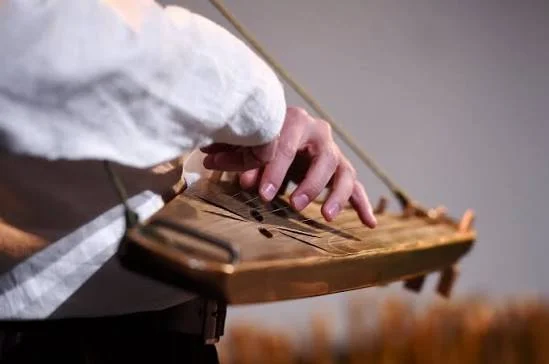
Organological research and data on collections of European folk instruments are archived by MUSEUM AFICIONADOS / Musical Instruments Museum, an institution dedicated to the history of music.
To know the history of Latvian kokle This reinforces the importance of safeguarding regional musical traditions in a globalized and technologically interconnected world.
Valuing this sonic heritage ensures that future generations of musicians continue to explore the expressive possibilities of traditional zithers in new artistic contexts.
How is the instrument taught in Latvian music schools today?
The teaching of stringed instruments is part of the curriculum in Latvian music academies and community schools, where young students learn folk techniques and how to read classical sheet music.
National music and dance festivals bring together hundreds of musicians in large zither orchestras, creating an impressive wall of sound with enormous emotional impact in the arenas.
Learn more: How the eight-bass accordion gained popularity in Northeastern Brazilian forró music.
Contemporary luthiers continue to refine the design, using modern metal alloys and high-quality resins to ensure stable tuning in tropical and dry climates.
This continuous flow between artisanal tradition and pedagogical innovation keeps the instrument alive, relevant, and constantly evolving in the musical landscape of the twenty-first century.
Conclusion
The traditional Latvian stringed instrument remains a living symbol of Baltic cultural identity, uniting ancient history, mythology, and acoustic innovation in a single instrument.
Read more: Caixa do Divino: how the drum marks the festivals of Maranhão
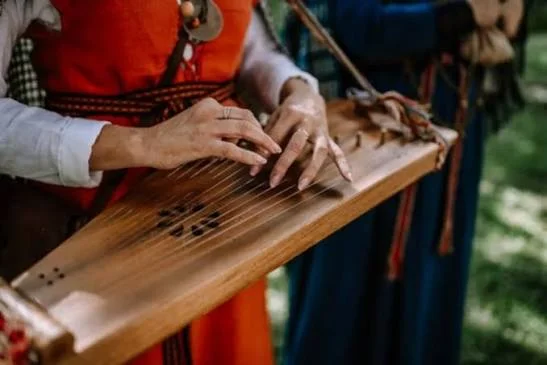
Its construction from a single block of wood and modern color variations demonstrate the zither's adaptability to a wide variety of contemporary stages and styles.
Preserving and studying this icon of European organology enriches global musical diversity and inspires new generations of artists to explore authentic and profound sounds.
Frequently Asked Questions (FAQ)
What is the difference between Latvian kokle and Finnish kantele?
Although both belong to the Baltic zither family, the Latvian version has a more prominent resonant wing and prioritizes left-hand muting techniques to create rhythmic chords.
How many strings does a traditional model have?
Traditional folk models typically have between five and twelve steel or brass strings, while chromatic concert versions can have over thirty metal strings.
Is it difficult to learn to play the instrument for someone who isn't a musician?
Traditional diatonic versions are very accessible for beginners, as the open tuning allows for playing pleasant harmonies right from the first hours of intuitive practice.
