
Tutorial on rapid musical transposition using intervals.
Learning to master fast musical transposition Through interval theory, it transforms the relationship of any instrumentalist, arranger, or singer with the practical execution of their scores and chord charts.
Advertisements
Changing the key of a composition in real time without relying on editing software requires understanding the exact distances between the notes that make up the Western scale.
What are intervals and how do they underlie transposition?
An interval is the exact distance in pitch, measured in semitones, between two distinct musical notes played consecutively or simultaneously.
Understanding these intervals allows one to move the entire structure of a melody without altering its auditory identity, preserving the original relationship of consonance and dissonance.
The chromatic scale has twelve semitones, functioning as a universal ruler to calculate the change in tonality of any piece without typos.
Advertisements
Apply to fast musical transposition It requires memorizing whether the degrees of the key advance by whole tones or by semitones along the scale.
How do you transpose a chord progression in practice?
The first step in moving a piece of music is to identify the original key and calculate the interval distance to the desired target key.
If a song is in C major and needs to go to E major, the ascending interval is a major third, equivalent to two whole tones.
Next, apply that same exact distance to each of the notes or chords that make up the harmony of the original piece.
To research theoretical materials on musical acoustics, the physics of sound, and traditional musical notation in educational institutions globally, visit [website/link]. Library of Congress.
This mathematical methodology ensures immediate accuracy during live rehearsals, preventing incorrect notes that could compromise the harmony and arrangement of the performance.
What are the most common interval distances in practice?
Visually mapping the most frequently used intervals facilitates the quick reading of arrangements and the instantaneous alteration of the harmonic field on the instrument.
Each interval has a fixed number of semitones that must be added to or subtracted from the root note of the chord being analyzed.
The table below organizes the standardized interval distances in the tempered system to serve as a practical guide for quick reference during your daily studies:
| Interval Name | Distance in Semitones | Practical Example (Starting from C) | Common Application in the Arrangement |
|---|---|---|---|
| Second Largest | 2 Semitones (1 Tone) | Do to Re | Smooth modulation of a semitone above |
| Major Tuesday | 4 Semitones (2 Tones) | Do to Mi | Change of tone for high-pitched voices |
| Fair Wednesday | 5 Semitones (2.5 Tones) | Do to Fa | Adaptation for wind instruments |
| Fair Thursday | 7 Semitones (3.5 Tones) | Do to Sol | Reinterpretation of male vocal arrangements |
Analyzing these interval distances allows for the fluid calculation of the new key, making the mental process natural and automatic during live performances.
Why is interval transposition superior to rote memorization?
Memorizing fixed chord sequences limits the musician to a memorized repertoire, creating creative blocks when faced with unforeseen events during performances and recordings.
The interval approach teaches the logic behind harmonic construction, allowing you to easily play the same song in twelve different keys.
Read more: Alto Saxophone vs. Tenor Saxophone: Which Is Better for Beginners?
Singers often request pitch adjustments to adapt their vocal range to their vocal tessitura without compromising the reach of the higher notes.
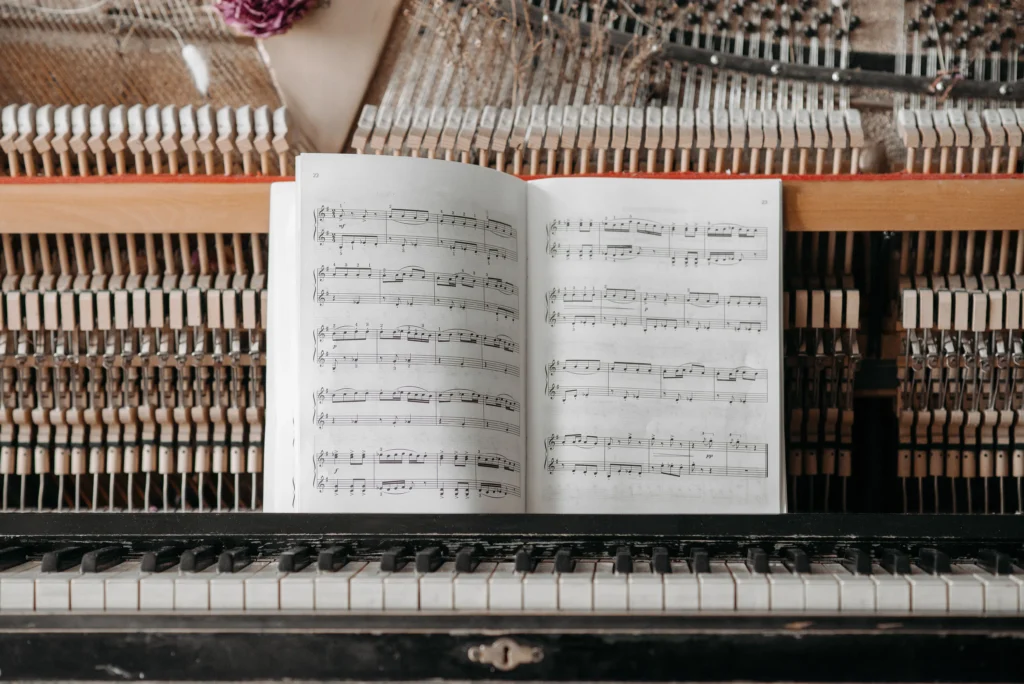
Master the fast musical transposition It offers the technical freedom to solve these problems on stage without interrupting the flow of the performance or rehearsal.
When should you use degree-based reading of the harmonic field?
Replacing note names with Roman numerals represents the pinnacle of harmonic fluency in reading and writing sheet music and commercial notation.
A common progression consisting of I – V – vi – IV in C major translates directly to the chords C, G, A minor, and F.
If you need to move that same idea to the key of G major, the numerical structure instantly generates G, D, E minor, and C.
Learn more: What is a harmonic field and how to apply it in everyday life?
To explore academic research on auditory perception, the neuroscience of musical cognition, and analytical theories of Western music, please consult the Stanford University.
Thinking in terms of harmonic functions accelerates musical reasoning, making transposition an automatic and intuitive mental process for the professional arranger.
Technical evolution and harmonious autonomy for your routine in 2026.
Practicing pitch conversion using intervals consolidates your auditory perception and raises the technical level of your musical interpretation in everyday life.
Read more: How to adapt complex songs for beginners
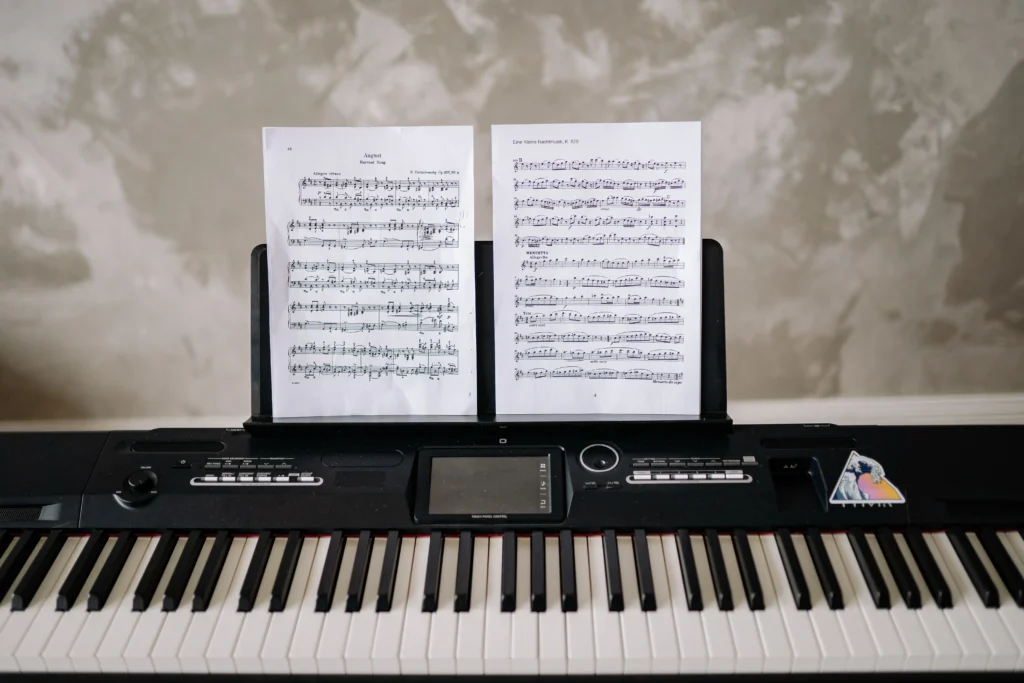
THE fast musical transposition It ceases to be a complex challenge and begins to act as a practical tool at the service of your creativity on the instrument.
Dedicate a few minutes each day to transposing short melodic phrases, expanding your theoretical knowledge and ensuring complete technical confidence in any musical situation.
FAQ (Frequently Asked Questions)
What is the difference between transposing by semitones and transposing by harmonic degrees?
Transposing by semitones focuses on the physical distance between notes, while transposing by degrees analyzes the harmonic function of the chord within the harmonic field.
How can you quickly transpose a piece of music if the instrument is a transposing instrument like a trumpet or saxophone?
You must add or subtract the tuning range of the instrument (for example, a tone higher for instruments in B-flat) in relation to the piano's key.
Is it easier to transpose by raising or lowering the original key?
This depends on the interval distance; generally, it is calculated using the shortest path in the circle of fifths to reduce the number of semitones in the mental conversion.
Can I use this method to transpose chords with minor, seventh, and other extensions?
Yes. The structure of chord extensions (such as sevenths and ninths) remains identical; you just need to change the root note of each chord following the correct interval.
