
How to develop children's sound perception through creative games.
Learn to Developing children's auditory perception through creative games. It is one of the most effective strategies for stimulating cognitive development and aesthetic sensitivity in preschool and school-aged children.
Advertisements
In 2026, educators and parents will seek methods that combine playfulness with neuroscience, understanding that active listening shapes language, memory, and focus skills, preparing children for future academic challenges.
In this guide, we'll explore how to transform your home or school environment into a vibrant sound lab.
We will analyze the connections between hearing and literacy, as well as offer practical suggestions for activities that use accessible materials to sharpen the hearing and imagination of Brazilian children.
What is sound perception and why is it vital in childhood?
Sound perception is the brain's ability to interpret and organize information captured by the auditory system.
Advertisements
In childhood, this ability allows the child to recognize the parents' voices, differentiate the sounds of nature, and eventually decode the phonemes necessary for fluent reading and writing.
When we encourage the child to Developing children's auditory perception through creative games., We are strengthening the neural connections responsible for auditory discrimination.
This prevents future difficulties in phonological processing, ensuring that learning occurs naturally, enjoyably, and connected to the emotional and artistic world that music provides.
Recent studies indicate that children exposed to active listening training demonstrate greater ease in learning new languages.
Brain plasticity at this stage allows for rapid refinement of hearing, transforming abstract sounds into clear meanings, which expands vocabulary and self-confidence during social interaction.
How can we create activities that encourage the discrimination of timbres?
Identifying the source of a sound is the first step in musical literacy. Games like "Sound Bingo" or "Sound Hunt" hidden around the house are excellent for teaching children to distinguish between different sounds, such as the metal of a utensil or the wood of a wooden spoon.
You can record everyday sounds — such as rain, a car engine, or a bird singing — and ask the child to associate them with images.
This practice exercises auditory memory and the ability to abstract, essential skills for the development of logical and spatial intelligence in the early years.
According to the portal of Brazilian Association of Music Education (ABEM), Sound education should be integrated and cross-cutting.
Using the body as a percussion instrument, for example, helps the child understand the relationship between movement, vibration, and the resulting sound.
Categories of Auditory Stimulation and Suggested Activities
| Sound Category | Educational Objective | Suggested Practical Activity | Materials Needed |
| Intensity | Understanding Strong vs. Weak | Follow the Master: heavy or light steps. | Free space. |
| Height | Differentiating between severe and acute conditions. | Animal Dance: Elephant vs. Bird. | Varied music. |
| Duration | Short vs. Long Sounds | Blind Drawing: tracing lines according to the sound. | Paper and pencil. |
| Stamp | Recognizing Sound Sources | Mystery of the Box: Guess the hidden object. | Shoebox. |
| Rhythm | Coordination and Pulse | Echo of Clapping: repeating rhythmic sequences. | The body itself. |
What are the benefits of using recyclable materials in learning?
Making instruments from reusable materials, such as PET bottles and grains, teaches about sustainability and basic acoustics.
By building a rattle, the child realizes how the size of the grain alters the texture of the sound, encouraging constant experimentation and natural scientific curiosity.
These manual activities complement the effort to Developing children's auditory perception through creative games., because the child becomes the creator of their own auditory universe.
The physical manipulation of sound objects reinforces body awareness and fine motor skills, connecting the senses of touch and hearing in a complete multisensory experience.
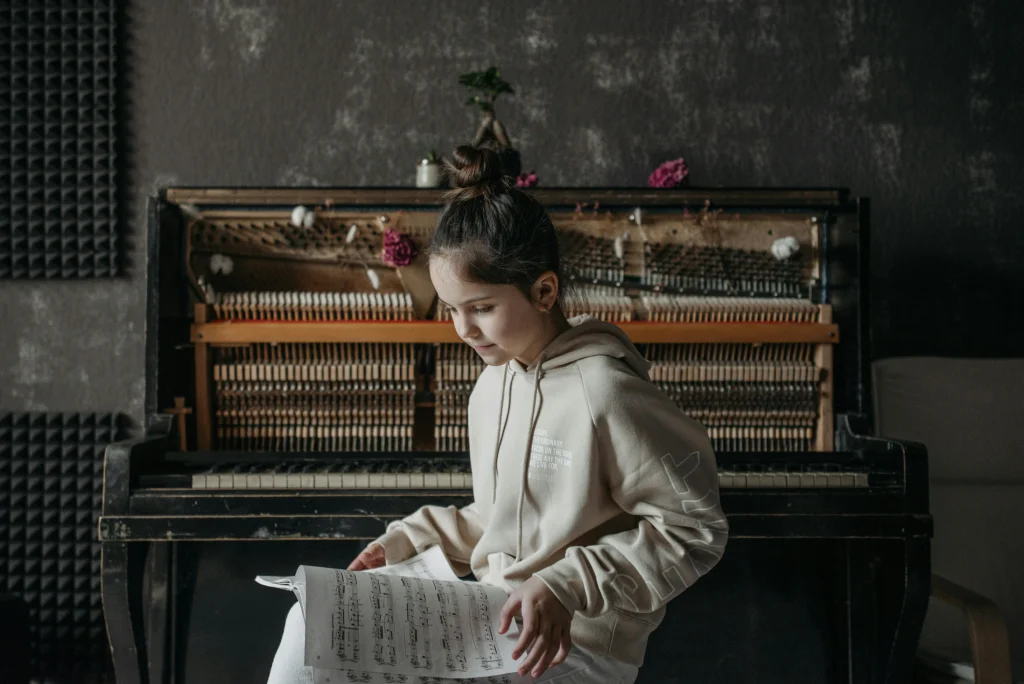
Furthermore, the use of recyclable materials democratizes access to music.
You don't need to invest in expensive instruments to start learning music; rhythm is present in the banging of pot lids and in exploring different types of paper, which can be crumpled or torn to produce unique sound effects.
Why is silent listening fundamental to perception?
In a world saturated with visual stimuli and constant noise, teaching the value of silence is a powerful pedagogical practice.
Suggesting "minutes of silence" where the child must report the farthest sound they can hear helps calm the nervous system and improves attentional focus.
Read more: A practical guide to listening to music for children, according to experts.
This practice of mindfulness Sound allows young children to identify subtle sounds, such as their own breathing or the wind in the leaves of trees.
This refined sensitivity is the foundation for deep musical appreciation and the development of empathy, as the child learns to listen to others with full attention.
Integrating moments of pause amidst hectic games teaches about dynamics and contrast.
The alternation between intense sound and absolute silence creates a dramatic and expressive awareness that will be fundamental if the child decides to formally study a musical instrument in the future, such as the piano or violin.
When should you start introducing rhythmic games into the routine?
Rhythmic games can be introduced from the first months through lullabies and lap games.
As the child grows, the use of clapping, foot stomping, and short rhymes helps to internalize the basic pulse, which is the heart of any organized musical structure.
Games like "Statue" or following the rhythm of a song by varying the speed (tempo) are fundamental.
Learn more: Group Musical Games for Children Up to 8 Years Old
To the Developing children's auditory perception through creative games., Rhythm acts as a mental organizer, aiding in the understanding of logical sequences and simple mathematical patterns, frequently found in traditional Brazilian circle games.
The repetition of rhythmic patterns also strengthens short-term memory.
When a child is able to repeat a sequence of three taps, they are exercising the prefrontal cortex, the area responsible for planning and executing complex tasks, which has a positive impact on all areas of academic and personal learning.
How can technology help with sound education in 2026?
Current technology offers sound synthesis and wave visualization applications that fascinate children.
Software that transforms drawings into sounds or that allows the creation of loops Simple diagrams facilitate the understanding of abstract concepts, such as frequency and modulation, in a playful and highly visual way.
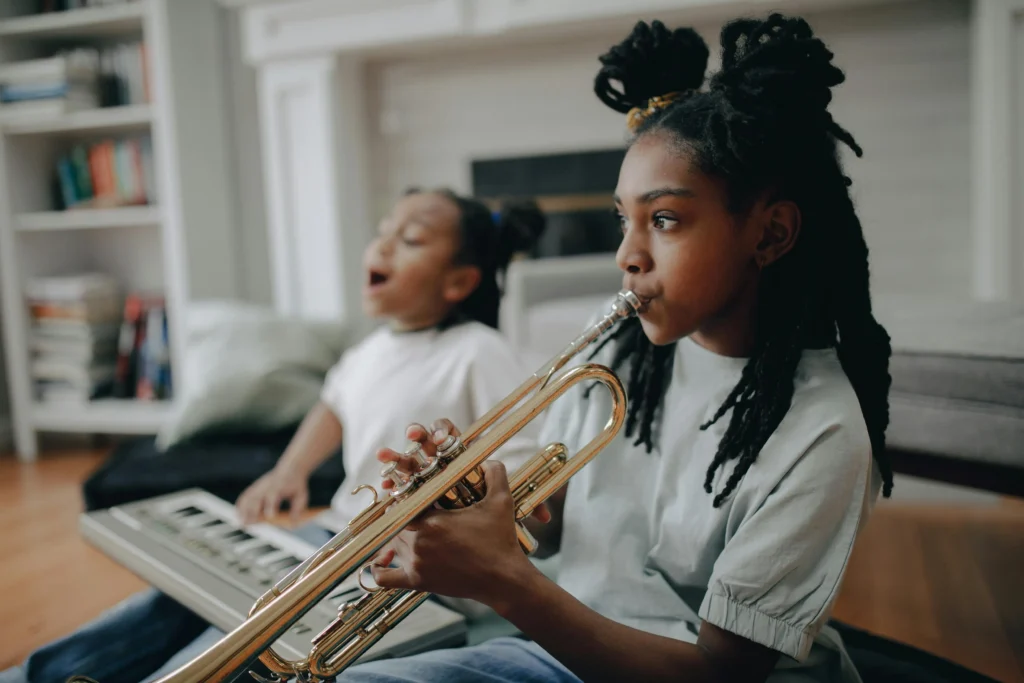
However, the use of screens must be balanced with real acoustic exploration.
Read more: Musical games to teach rhythm to children at home
Ideally, technology should be used as a complement to record children's compositions or to explore instruments from other cultures that are not physically available, expanding cultural repertoire and tolerance for global sound diversity.
To understand the health guidelines and ideal screen time for each age group, visit the website of Brazilian Society of Pediatrics (SBP) It provides updated manuals.
Following these recommendations ensures that technological stimulation is beneficial for neurological development and does not harm the hearing health or sleep of young children.
FAQ: Frequently Asked Questions about Sound Perception
My son has no rhythm, do the games still work?
Yes, rhythm is a skill that can be developed with consistent practice. Often, the child simply needs more time to coordinate physical movement with auditory stimuli. The key is to keep activities fun and without pressure for immediate technical results or perfection.
What is the ideal age to start music education for children?
Musical education begins in the womb, but structured creative play is ideal from the age of two. At this stage, the child has greater motor control and curiosity to explore objects, making learning much more dynamic and interactive for parents and educators involved.
Which household objects are best for creating sounds?
Plastic containers of different sizes, wooden spoons, keys, rice in metal cans, and even paper straws. The kitchen is a veritable orchestra waiting to be discovered, provided the objects don't pose a cutting risk or contain small parts that could be accidentally swallowed.
Investing time for Developing children's auditory perception through creative games. It's about giving children the necessary tools to interpret the world with greater depth and beauty.
Through attentive listening, she not only learns about music, but develops patience, discipline, and an intellectual curiosity that will stay with her throughout her life.
The role of adults is to provide the right stage and stimuli, allowing each sound to become a new discovery. In 2026, with so many digital distractions, reclaiming the purity of organic hearing is an act of caring for the mental and cognitive health of future generations.
Whether through a popular song or the sound of a stream, sound education is the path to a holistic, sensitive, and harmonious human development.
