
Testing the Zoom H1 XLR for outdoor music recording.
The portable recorder Zoom H1 XLR It redefined mobile audio capture by combining professional balanced inputs and 32-bit float recording technology in a compact chassis.
Advertisements
Musicians, producers, and sound engineers who record outdoors constantly face severe challenges, such as wind noise, abrupt changes in dynamics, and power outages.
The purpose of this equipment is to eliminate the need to manually adjust the input gain before recording a live performance, a street rehearsal, or an acoustic sample.
In this detailed test, we analyzed the practical performance of the preamplifiers, battery life, and frequency response of this device under real and demanding field recording conditions.
What is 32-bit float technology and why is it crucial in outdoor applications?
The 32-bit float digital conversion architecture uses two parallel analog-to-digital converters to simultaneously capture extremely low signals and incredibly high volume peaks without distortion.
Advertisements
This technology eliminates the traditional saturation indicator, allowing the recovery of audio that would sound distorted or inaudible on conventional 16- or 24-bit systems during the editing process.
In outdoor musical performances, where a soft guitar might be followed by a violent percussion attack, this dynamic range ensures signal preservation without constant manual intervention.
The recorder Zoom H1 XLR It utilizes this modern conversion to deliver an agile workflow, allowing the artist to focus exclusively on musical interpretation without technical concerns.
How do the preamps and XLR inputs perform in the field?
The integrated XLR/TRS combo connections feature safety locks and ultra-low background noise preamps, capable of powering condenser microphones with stabilized 48V phantom power.
The flat frequency response ensures that the natural timbral character of acoustic instruments, voices, and percussive sources is captured with studio-worthy analog fidelity and transparency.
In addition, the secondary stereo P2 input accepts line-level signals, facilitating direct connection to external mixing consoles, lavalier microphones, or portable electronic instruments.
The absence of internal microphones in the device's body reduces overall weight and forces the user to utilize dedicated external microphones, improving the final recording quality.
Technical Specifications and Practical Performance of the Recorder
| Technical Parameter | Manufacturer's Actual Specification | Practical Impact on External Recording |
| Audio Resolution | 32-bit float / 96 kHz | Zero clipping distortion and infinite dynamic range. |
| Audio Inputs | 2x XLR/TRS Combo + 1x 3.5mm stereo | Professional connectivity with microphones and mixing consoles. |
| Equivalent Noise (EIN) | -122 dBu or lower | Clear audio even when capturing weak sound sources. |
| Food and Energy | 2 AA batteries or USB-C Bus Power | Flexible autonomy for long sessions in the field. |
Why do ergonomics and accessible controls facilitate quick data capture?
The front panel features a high-contrast OLED screen that remains perfectly readable even in direct sunlight on sunny days during outdoor recordings.
The shortcut buttons allow you to activate phantom power, low-cut filter, and headphone output without navigating through complex or confusing menus.
The body, constructed from rubberized polymer, reduces handling noise when attached to articulated stands, cameras, or handheld recorders used by film crews.
Read more: Zoom portable recorder test for essays and studies.
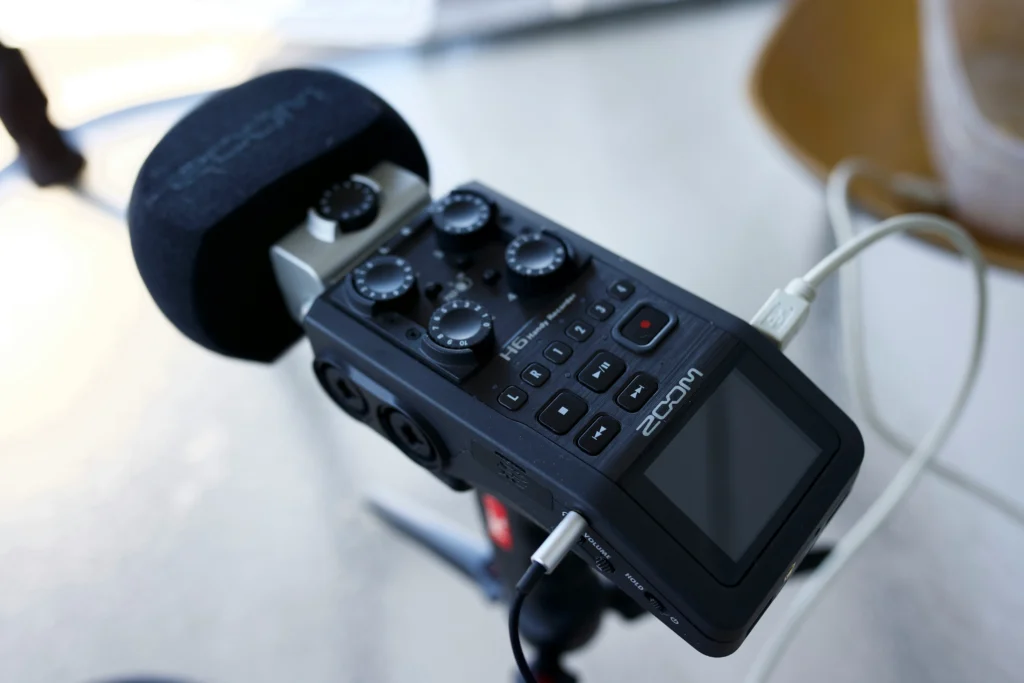
For detailed reviews of audio equipment, studio tests, and specifications of professional microphones, visit the portal. Sound on Sound.
What operational limitations should you consider before purchasing?
Power consumption increases considerably when 48V phantom power is active on both XLR inputs, requiring the use of high-capacity rechargeable batteries.
The absence of a built-in microphone capsule requires you to carry cables and external microphones in your backpack, making the recording kit slightly larger and heavier.
Learn more: Mirrored test tutorial to correct technical errors.
The internal software does not allow for the application of real-time equalization effects, keeping the audio file completely clean for later processing on a digital workstation.
Investing in Zoom H1 XLR It is essential to understand that this equipment functions as a high-precision portable audio interface, focused strictly on high-fidelity field recording.
How to optimize battery life and signal quality when outdoors?
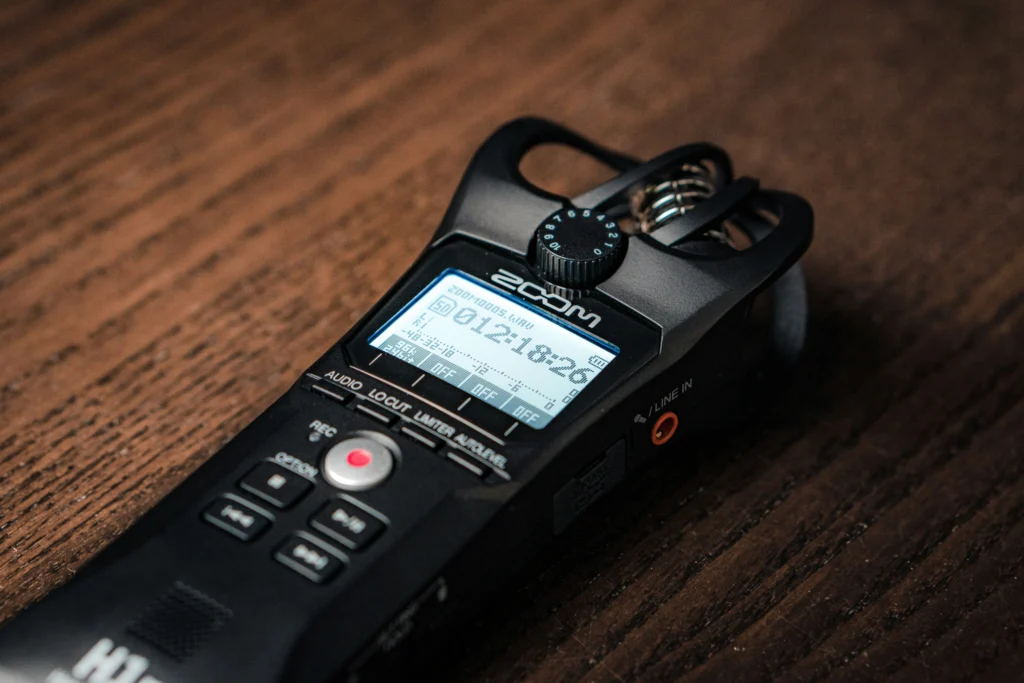
Use wind protectors of the type deadcat in their external microphones to prevent air blasts from saturating the mechanical diaphragms during intense weather gusts on site.
Opt to power the device via an external power bank connected to the USB-C port when performing continuous recordings of live shows or long rehearsals in remote locations.
Read more: How to use a loop station for practice and gain accuracy.
Keep your device's firmware properly updated to ensure operating system stability and correct recognition of high-speed microSDXC memory cards.
To explore radio frequency technical homologation standards, safety norms, and electronics specifications in Brazil, visit the official website of [website name/organization name]. National Telecommunications Agency (ANATEL).
FAQ – Frequently Asked Questions
Does the recorder have microphones built into its structure?
No, this model does not include internal microphones and focuses exclusively on XLR/TRS combo inputs and a P2 auxiliary input for connecting professional microphones and external sources.
Can I use the device as an audio interface on my computer or mobile phone?
Yes, the device functions as a USB audio interface with 2 inputs and 2 outputs, transmitting a 32-bit float signal directly to computers, tablets, or smartphones.
Which memory card is recommended to avoid write errors?
It is recommended to use class 10 or UHS-I microSDHC or microSDXC cards with a capacity of up to 1 TB to support continuous file transfer rates.
The choice of Zoom H1 XLR It's ideal for those seeking maximum portability without compromising preamp quality. The 32-bit float technology ensures perfect, reliable recordings, ready for post-production.
