
Discover the Arabic rebab that influenced the European violin.
Studying the history of Arabic rebab It allows us to understand the fascinating Eastern roots that shaped the development of bowed string instruments in medieval and Renaissance Europe.
Advertisements
Long before the great Italian luthiers designed the perfect curves of the modern violin, Islamic classical music was already using horsehair bows to produce expressive melodies.
Trade routes and cultural expansions across the Mediterranean Sea facilitated the introduction of these ancient tools to the Iberian Peninsula and southern Europe.
Understanding this organic evolution reveals how the exchange of artisanal techniques and musical aesthetics between continents forever transformed the history of modern Western music.
What is the ancient bowed string instrument from the East?
It is a traditional instrument constructed with a wooden soundbox, covered with stretched animal skin, and played with a curved wooden bow.
Advertisements
Its strings, originally made of horsehair or gut, produce a nasal, melancholic sound rich in harmonics, perfect for complex melodic ornamentation.
The absence of frets on the instrument's neck demands extreme auditory precision from the musician to achieve the microtonal nuances characteristic of traditional Arabic Maqamat.
Analyze the anatomy of Arabic rebab It demonstrates ingenious acoustic solutions that allowed for the projection of sound in royal courts and popular gatherings since the Middle Ages.
How did the historical and cultural transition to the European continent occur?
During the Middle Ages, the Moorish presence in Spain and the intense commercial contacts in Sicily introduced the instrument to artistic circles in Europe.
European artists gradually adapted the original design, replacing the leather top with wood and modifying the body shape to make it easier to grip.
From this stylistic fusion emerged medieval instruments such as the rebec and the vielle, fundamental intermediate stages before the appearance of the first violins in Italy.
Medieval manuscripts and ecclesiastical frescoes document this rapid assimilation, showing local minstrels performing festive melodies with Westernized variations of the original Eastern model.
Technical Comparison Between Bowed String Instruments
| Technical Characteristic | Traditional Oriental Model | European Medieval Rebecca | Modern Western Violin |
| Tabletop Material | Parchment or fish skin | Carved wood (Spruce) | Solid spruce wood |
| Number of Strings | 1 to 2 main strings | 3 strings tuned in fifths | 4 strings tuned to GDAE |
| Execution Position | Vertical (Supported on the knee) | Supported on the chest or shoulder | Supported between chin and shoulder |
| Scale / Mirror | No frets or flat mirror | Flat wooden arm | Curved ebony mirror |
Why did the acoustics of the skin-covered soundboard influence lutherie?
The transition from stretched skin to a resonant wooden soundboard represented a decisive milestone in the quest for greater volume and auditory projection.
Read more: Medieval instruments that influence music to this day.
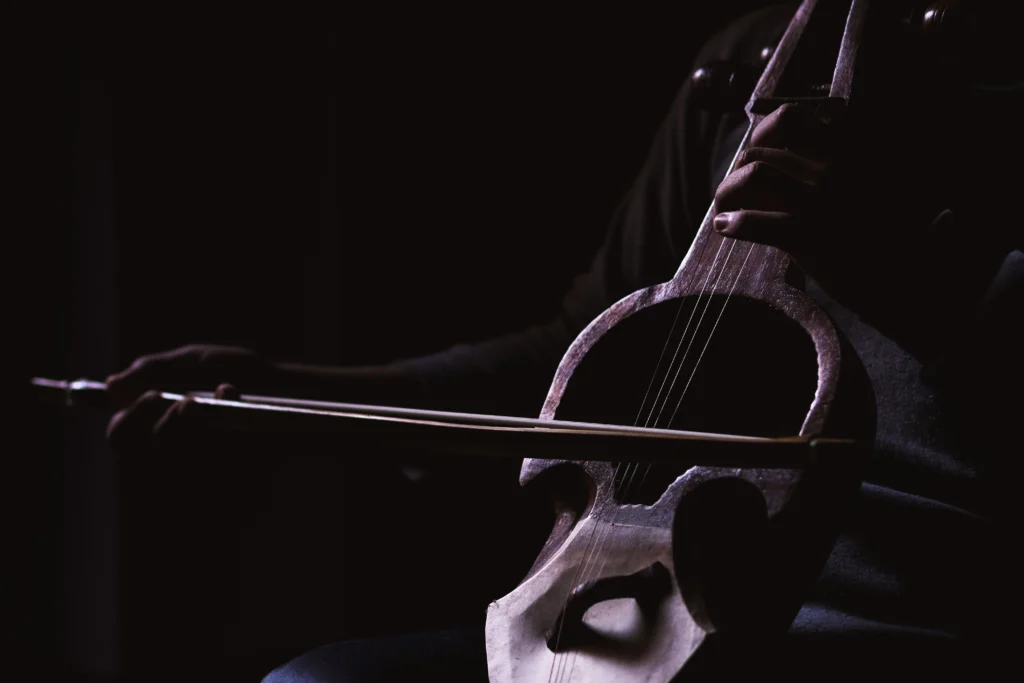
While the skin offered a velvety and intimate tone, the wood allowed for greater string tension, expanding the sonic dynamics needed in larger rooms.
European luthiers retained the structure of bowed strings, but refined the physics of the acoustic body to create a brighter sound.
Explore collections and research on global musical heritage preserved by United Nations Educational, Scientific and Cultural Organization (UNESCO) to deepen your knowledge.
What aesthetic elements remain alive in contemporary music?
The technique of rubbing strings using horsehair coated with rosin remains the fundamental basis of the entire violin family.
Several modern classical and folk composers are reviving alternative tunings and original microtonalities to enrich orchestral arrangements and film soundtracks.
Learn more: Discover the Viking tagelharpa and its unique, ancient sound.
Furthermore, master craftsmen from the Middle East preserve centuries-old construction methods, keeping alive the authentic craftsmanship for prestigious traditional performances.
Enjoy the sound of Arabic rebab It connects the listener to a millennia-old legacy that transcends geographical boundaries, celebrating the continuous evolution of universal art.
Where can we find historical records and archives of this musical heritage?
Museums of musical instruments in Europe and the Middle East preserve rare examples that perfectly illustrate the transitional phases of this fascinating art form.
Public collections provide detailed digital catalogs with acoustic radiographs, allowing contemporary researchers to study the density of materials and their original thicknesses.
Read more: Discover the oud, an ancient Arabic instrument.
Modern music students and luthiers use this historical data to build faithful replicas aimed at performing historical repertoires with technical rigor.
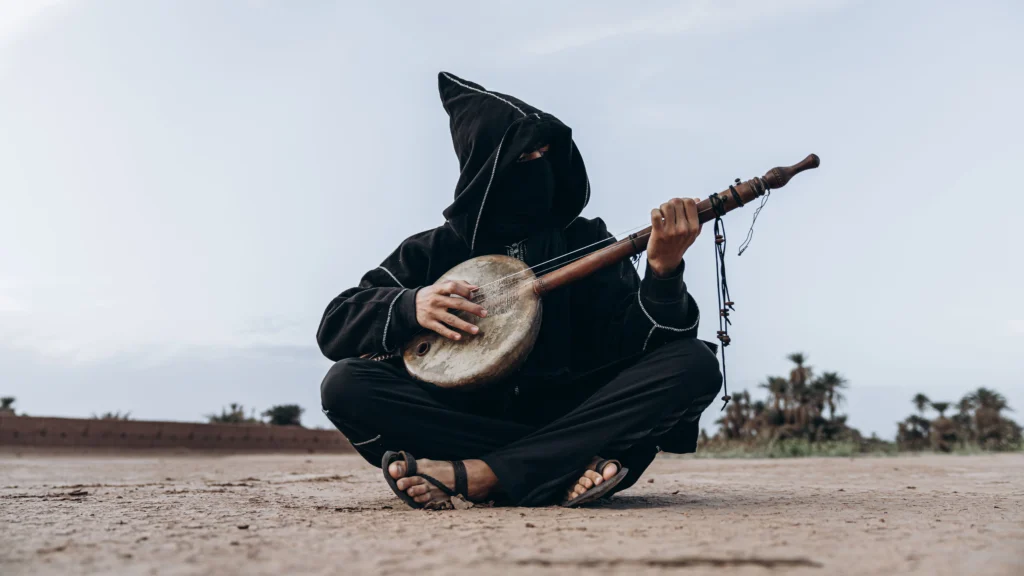
Access the database and virtual displays of historical instruments maintained by Metropolitan Museum of Art (MET) to view preserved models.
Frequently Asked Questions (FAQ)
Is the oriental instrument played in the same position as the violin?
No, while the violin is supported between the chin and shoulder, the traditional instrument is played vertically, resting on the musician's knee.
How many strings does an authentic traditional model have?
Most traditional models have only one or two strings made of horsehair or gut, depending on the region and musical tradition.
What is the main difference in sound between them?
The oriental model produces a more nasal and intimate sound due to the skin top, while the violin emits a brighter and more powerful sound.
Is it possible to play Western music in the ancestral style?
Yes, although it's designed for Eastern microtonal scales, an experienced musician can play Western melodies by adjusting the finger position on the fretboard.
Recognizing the historical role of Arabic rebab The creation of the violin is about valuing the richness of cultural exchange between different peoples throughout the centuries.
This musical bridge between East and West demonstrates how art transforms, preserving its essence while inspiring new forms of expression and beauty.
