
How to stimulate children's auditory memory through play.
Knowing how to stimulate children's auditory memory Through playful activities, it strengthens children's ability to retain, process, and retrieve auditory information that is fundamental for learning.
Advertisements
This cognitive skill directly impacts the retention of verbal instructions, the comprehension of spoken language, and the development of focus during daily school activities.
Structured play transforms neuropsychological training into enjoyable moments, stimulating sound discrimination and the sequential ordering of clicks, words, or rhythms without causing fatigue.
We will analyze practical strategies, adapted traditional games, and interactive activities that parents and educators can easily apply to enhance auditory processing in a healthy way.
What is auditory memory in children and how does it work?
This cognitive function of the brain allows it to store and recall information perceived by the auditory system, organizing sound sequences to interpret speech accurately and quickly.
Advertisements
It acts as a direct bridge to phonological awareness, enabling the child to recognize phonemes, differentiate similar syllables, and understand multi-step verbal commands.
Difficulties in this area can lead to apparent inattention, literacy problems, and slowness in following simple instructions given by adults in daily family or school settings.
Understanding this cognitive mechanism reinforces the importance of to stimulate children's auditory memory from early childhood with activities that involve sounds, rhythms and gradual repetitions.
Which traditional games help train sound retention?
Classic games like "I Went to the Fair and Bought" challenge children to memorize a growing list of words, exercising sequential retention in a fun way.
The famous game "Telephone" requires attentive listening and accurate reproduction of short messages, demonstrating in practice how distraction alters the interpretation of the information heard.
Playing games that involve repeating sequences of clapping or drumming to develop rhythm, sustained attention, and the ability to mirror sound patterns with motor precision.
The game "Follow the Sound Leader," where children only obey commands given in whispers, sharpens auditory discrimination in environments with background noise.
Comparison of Play and Auditory Skills Developed
| Recommended Game | Suggested Age Range | Focus of Cognitive Training | Main Benefit for Learning |
| I went to the fair and bought | From age 5 onwards | Sequential auditory memory of words | Expanding vocabulary and retaining lists. |
| Echoes of Clapping and Rhythms | From 3 years old | Temporal processing and rhythm perception | Improved sustained attention and coordination. |
| The Mystery of Hidden Sounds | From age 4 onwards | Auditory discrimination and visual association | Ease in recognizing speech phonemes |
| Master's Secret Command | From age 5 onwards | Understanding multi-step orders | Agility in following classroom instructions. |
How to create a hidden sounds game at home?
Record everyday noises, such as the sound of rain, a cat meowing, a car horn, or doors opening, using your cell phone without showing the image.
Present the audio clips in isolation so that the child can identify the sound source and order the exact sequence in which the sounds were played during the challenge.
Read more: Musical improvisation games for children to stimulate creativity.
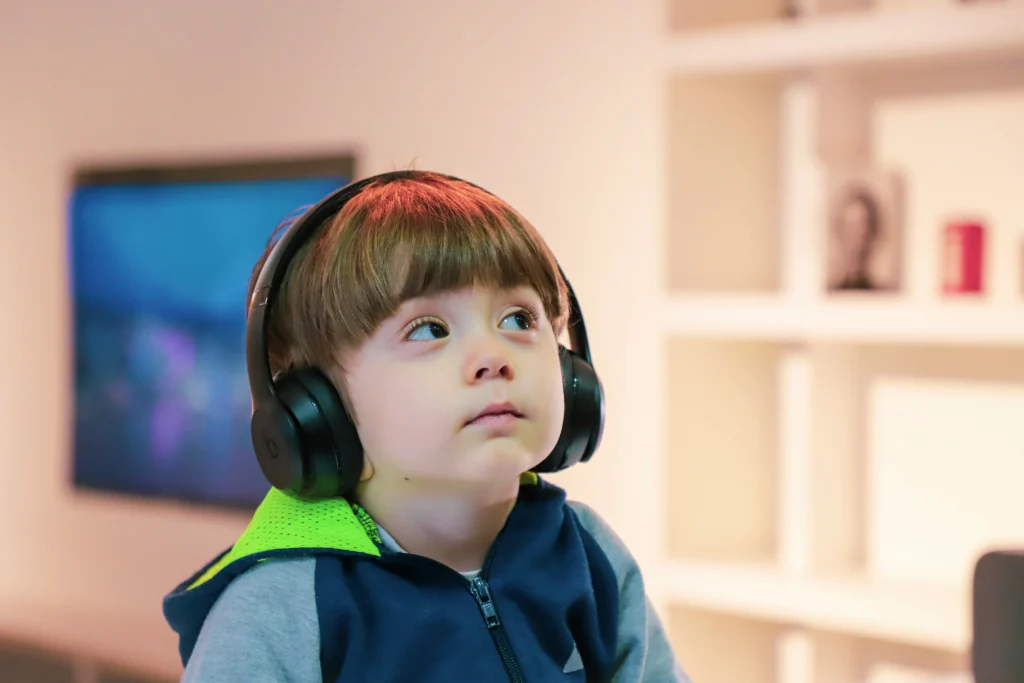
Gradually increasing the number of sounds in the sequence raises the level of difficulty, stimulating the brain to create strategies for association and mental retrieval.
Detailed guidelines on child development and learning milestones are available on the official website. Ministry of Education (MEC) for family consultation.
When should play activities be integrated into the routine?
Incorporating sound dynamics into a daily and natural routine, such as during car rides or family meals, avoids a feeling of pressure and keeps their interest active.
Short sessions of ten to fifteen minutes ensure high concentration, preventing mental fatigue and the disinterest characteristic of long and repetitive activities.
Learn more: Fandango tambourine: what changes in relation to the Brazilian pandeiro?
Varying the stimuli to include words, music, improvised instruments, and sounds of nature expands the repertoire of frequencies that the child's brain learns to process.
Celebrating successes with enthusiasm strengthens children's self-confidence, showing that to stimulate children's auditory memory It can be a lighthearted moment of connection and shared learning.
Why is music a powerful ally in auditory development?
Singing nursery rhymes that require memorizing cumulative verses stimulates brain plasticity, naturally associating rhythm, melody, and phonetic structure.
Identifying specific instruments within a song develops selective listening, teaching the brain to isolate relevant stimuli from secondary noises or crosstalk.
Read more: How to apply musical interleaved practice to repertoires

Matching the tempo of the music with body movements integrates auditory and motor pathways, enhancing the temporal perception necessary for fluent and rhythmic speech.
Technical information about the impact of music and neuroscience on health and human development is disseminated by Pan American Health Organization (PAHO) constantly.
Frequently Asked Questions (FAQ)
At what age should I start stimulating auditory processing?
Starting in the first months of life, with lullabies and direct conversation, evolving into games with simple rules from the age of three.
Does frequently forgetting verbal instructions indicate a serious problem?
Not always; it could simply be a lack of working memory training, but if the symptom persists, it's worth consulting a speech therapist for evaluation.
Do electronic toys with sound help train auditory memory?
They can help, but human and interactive play offers better social context, variation in intonation, and emotional engagement for the child.
How long does it take to notice an improvement in a child's attention span?
With daily, playful 10-minute practices, improvements in command retention and focus are usually noticed within a few weeks of consistent training.
Learn to to stimulate children's auditory memory Simple games can transform leisure time into valuable opportunities for cognitive development. Incorporating listening games, rhymes, and sound sequences into daily life prepares children for school challenges and improves their communication with the world.
