
How the octobasse works and its impressive size.
Understanding octobasse Its colossal dimensions reveal one of the most fascinating acoustic engineering feats in the history of classical music and 19th-century instrument making.
Advertisements
Created to reach infrasonic frequencies below the standard human hearing range, this giant of the string family challenges the physical limits of sound performed in large orchestras.
Exploring the mechanical workings of this monumental instrument allows us to understand the evolution of deep bass tones and the fascination it continues to exert on modern composers and musicians.
What is octobasse and who invented it?
The octobasse is the largest bowed string instrument ever built in the history of classical music, reaching almost four meters in total height.
Developed in Paris around 1849 by the renowned French luthier Jean-Baptiste Vuillaume, the instrument aimed to expand the bass range of the symphony orchestra of that time.
Advertisements
Vuillaume had the support and encouragement of the influential composer Hector Berlioz, who was seeking unprecedented low tones to fill the great European concert halls.
Only three original examples were manufactured during the 19th century, and they are currently preserved in prominent music museums located in Paris, Vienna, and Phoenix.
To explore the history of classical lutherie and collections of rare instruments in France, visit the portal of... Philharmonie de Paris.
How do the manual mechanism and pedals work on this giant acoustic guitar?
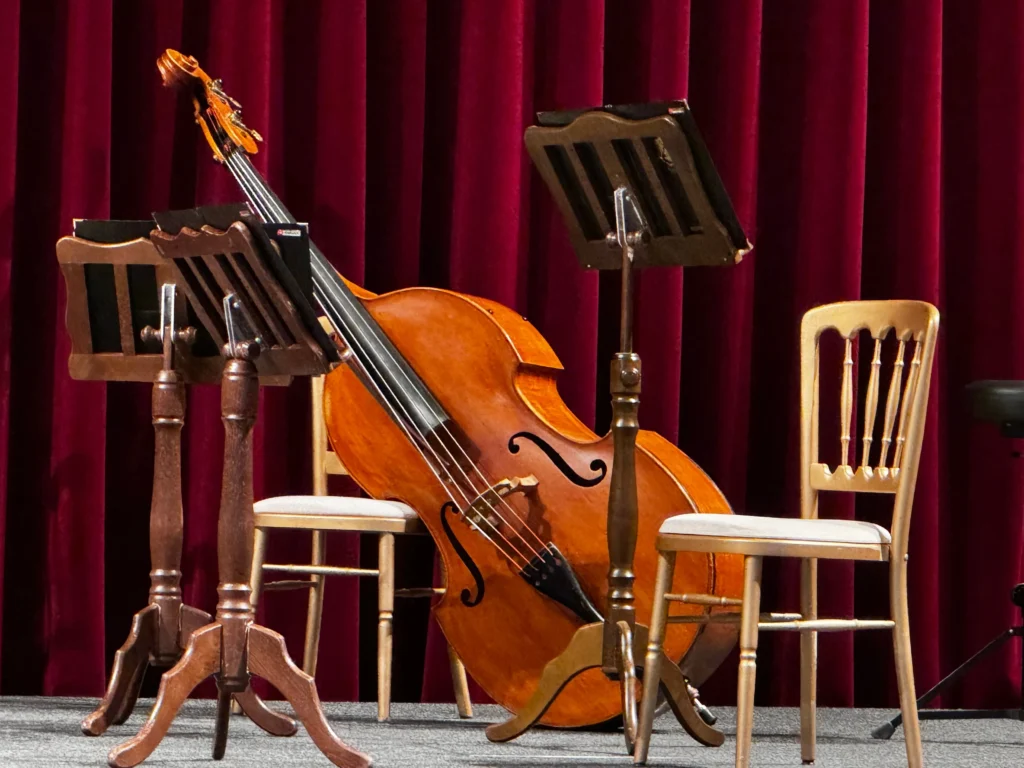
Due to its colossal height and extremely long neck, it is impossible for the player to press the strings directly with their fingers as on a regular double bass.
The French luthier resolved this biomechanical limitation by designing a complex system of wooden levers and metal pedals operated by the musician's foot on the stage.
The instrumentalist stands on a raised platform and manipulates the side levers, which activate wooden pads on the strings to alter the desired notes.
Interact with the mechanics of octobasse It demands impeccable motor coordination and physical strength, allowing the giant bow to rub extremely thick strings with harmonic precision.
Below, we present a table detailing the actual technical specifications of the instrument, comparing its dimensions and acoustic range with a traditional double bass used in a symphony orchestra.
| Technical Parameter | Traditional Octobasse | Standard Double Bass (4/4) |
| Total Height | Approximately 3.48 meters | Approximately 1.80 to 2.00 meters |
| Number of Strings | 3 braided gut strings | 4 or 5 steel/synthetic strings |
| Standard Tuning | C0 (16.35 Hz), G0, C1 | E1 (41.2 Hz), A1, D2, G2 |
| Execution System | Hand levers and pedals | Direct finger pressure on the mirror |
Analyzing this numerical data demonstrates the monumental scale of the mechanical engineering employed by Vuillaume to produce deep, vibratory notes that were physically perceptible to the audience.
Why are the notes produced by this instrument at the limit of human hearing?
The lowest string on the instrument is tuned to the note C sub contra, which vibrates at an impressive frequency of approximately 16.35 hertz per second.
The average human ear can perceive sound frequencies starting at 20 hertz, making the lowest note on an instrument a more physical than auditory experience.
This vibration generates deep resonances in the listeners' bodies, producing a tactile sensation of trembling in the walls and floor of the performance hall.
Musicians who have mastered the execution of octobasse They manage to add a unique subterranean harmonic foundation that fills the acoustic space with unparalleled grandeur and sonic mass.
Contemporary composers remain fascinated by this infrasonic capability, using the instrument in film scores and avant-garde works to create atmospheres of dramatic suspense.
Which modern orchestras use this instrument in their performances?
Although an absolute rarity, professional orchestras such as the Montreal Symphony Orchestra have acquired modern replicas to perform specific works by Hector Berlioz.
The giant's presence on stage requires complex logistical adaptations, including specialized transport in custom-made cases and physical space in the bass section.
Read more: Review of the Valeton GP-200LT pedalboard for gigs and practice.
The inclusion of this historical piece attracts the curiosity of new audiences, transforming classical concerts into truly unforgettable visual and acoustic events for the audience.
The technical learning required to handle the tremolo arms demands months of dedicated practice for experienced double bass players willing to master the mechanics of the French instrument.
Maintaining stable tuning for such thick strings presents another constant challenge for modern luthiers, requiring rigorous control of humidity and temperature in theaters.
When is it worthwhile to see an instrument of this caliber up close?
Visiting music museums that house original or working replicas provides a practical lesson in acoustic physics, art history, and mechanical engineering.
Appreciating the curvature of the wooden top and the complexity of the pedal system reveals the genius of 19th-century artisans in their quest for the perfect sound.
Learn more: Maintenance guide for Brazilian percussion instruments.
Understanding the history of this colossal stringed instrument makes us appreciate humanity's tireless pursuit of artistic innovation and the expansion of musical boundaries.
To search international collections of historical musical instruments, technical catalogs, and restorations of rare items, visit the database of... Musical Instruments Museum.
Preserving these relics ensures that future generations will continue to witness the grandeur and technical audacity of classical lutherie throughout the centuries.
The colossal legacy of French lutherie.
The giant created by Jean-Baptiste Vuillaume remains a monumental testament to artistic ambition and mechanical engineering applied to Western classical music.
Its ability to produce notes on the infrasound border continues to fascinate acousticians, composers, and sound enthusiasts throughout the contemporary world.

Read more: Tagima Baby Mahogany Ukulele: Small in Size, Big in Sound?
Preserving and performing this acoustic masterpiece ensures that the pursuit of deep and grand tones continues to thrive on the stages of the world's greatest orchestras.
FAQ (Frequently Asked Questions)
How many octobasses are there in the world today?
There are only three original 19th-century examples kept in museums, in addition to some modern working replicas built by specialized contemporary luthiers.
How does the musician manage to reach the strings of the instrument?
The musician stands on a raised wooden platform behind the instrument and operates mechanical levers and pedals that press the strings against the fretboard.
What is the lowest note the instrument can produce?
The lowest note produced is C0, tuned to approximately 16.35 hertz, an infrasonic frequency that lies at the perceptible limit of human hearing.
Can any double bass player play the instrument easily?
No, because the mechanics of levers and pedals require specific technical learning and considerable physical effort to articulate the instrument's thick strings.
