
Little-known Latin American string instruments
Explore the richness of Latin American string instruments It reveals a universe where wood and metal merge to narrate centuries of resistance and sonic innovation.
Advertisements
In 2026, the revival of peripheral musical traditions gains momentum, driven by luthiers who balance ancestral techniques with the urgency of sustainability.
This article delves into the rare sounds that inhabit the mountain ranges, jungles, and pampas, going far beyond the conventional guitar that dominates the radio.
We will investigate the anatomy and social context of pieces that, although they remain on the fringes of the general public, sustain the rhythmic identity of the continent.
Understanding these tools is to understand the soul of a people who make music their primary language of survival and celebration.
Advertisements
What are niche Latin American string instruments?
This is a broad category that encompasses stringed instruments developed from the colonial encounter, where European models were absorbed and transformed by indigenous and African hands.
These modifications resulted in timbres that respond to the local geography and the acoustic needs of each popular festival, far removed from formal conservatories.
There's something unsettling about realizing how names like "viola de cocho" remain largely unknown to most Brazilians.
Carved from a single block of wood, it possesses a percussive sound that underpins the Siriri and Cururu, fundamental dances of Mato Grosso.
This diversity shows that Latin American string instruments These are not merely simplistic variations of the guitar, but independent creations with "re-entrant" tunings.
They represent the embodiment of the cultural resistance of communities that refused to have their roots erased by aesthetic standardization.
How did geography shape the construction of these chordophones?
The availability of natural resources dictated the aesthetics and acoustics of each region, forcing ingenious solutions in folk lutherie.
In the Andes, the scarcity of large trees at high altitudes led to the creation of the charango, originally assembled from an armadillo shell.
Currently, this practice has been replaced by fine woods, while maintaining the oval shape that guarantees the instrument's characteristic bright projection.
This is often misinterpreted: changing the material didn't remove the soul of the sound, but rather enhanced its technical resonance.
To understand the relevance of these records to intangible heritage, the National Institute of Historic and Artistic Heritage (IPHAN) It offers detailed dossiers on the viola de cocho.
These documents explain why preserving the manufacturing technique is as vital as preserving the music itself.
What are the characteristics of the guitarrón and the vihuela?
In Mexico, the rhythmic foundation is supported by two giants that define the sound of mariachis: the guitarrón and the Mexican vihuela.
The guitarrón, with its convex back and imposing size, acts like an acoustic bass, producing powerful bass sounds without any electronic amplification.
The Mexican vihuela, small and with five strings, focuses on rhythm and harmonic brilliance, differing from the Spanish version by its more robust construction.
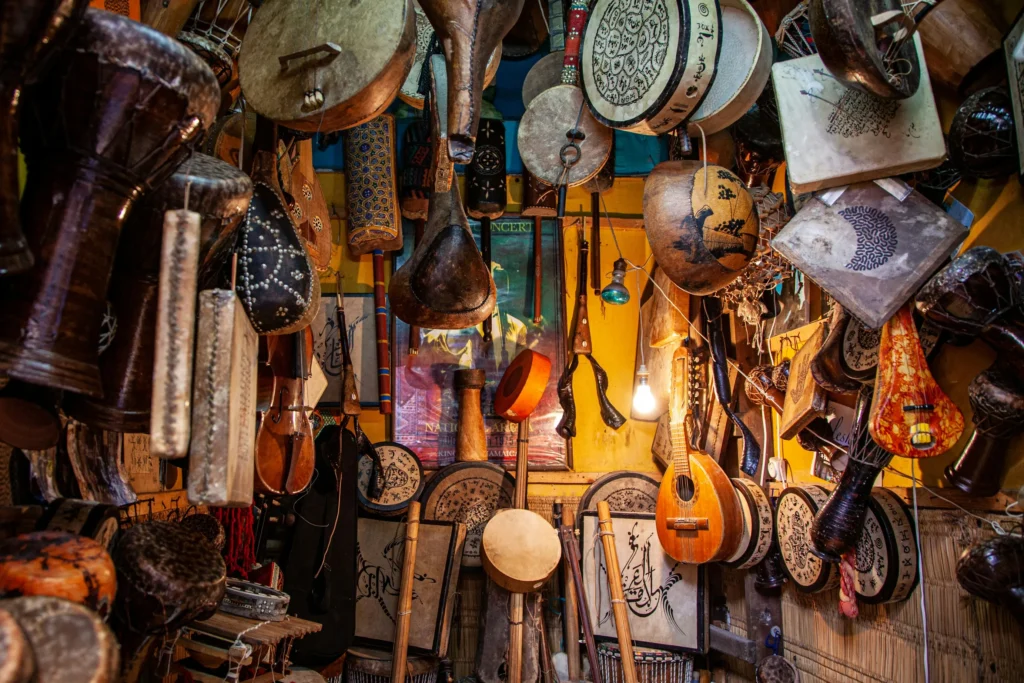
Both Latin American string instruments They require a vigorous right-hand technique to cut through the sonic mass of the brass instruments.
Read more: How to remove squeaking from old guitar strings
Unlike the acoustic guitar, the guitarrón has no frets, which allows for expressive glissandos that are the hallmark of Mexican ballads.
This lack of divisions demands from the musician perfect pitch and impeccable muscle memory in order not to lose the pitch in the middle of the performance.
Technical Specifications of Traditional Chordophones (2026)
| Instrument | Main Source | Number of Strings | Common Tuning | Material |
| Viola de Cocho | Brazil (Pantanal) | 5 | Sol-Do-Fa-La-Re | Ximbuva trunk |
| Charango | Bolivia / Peru | 10 (5 pairs) | Sol-Do-Mi-La-Mi | Solid wood |
| Guitarrón | Mexico | 6 | La-Re-Sol-Do-Mi-La | Cedar and Tacote |
| Four | Venezuela | 4 | La-Re-Fa#-Si | Lightweight wood |
| Paraguayan Harp | Paraguay | 36 to 40 | Diatonic | Cedar and Pine |
Why is the Paraguayan harp a marvel of adaptation?
The Paraguayan harp is a fascinating example of how European Baroque was digested and transformed into something purely native.
Unlike the concert harp, it is lighter, has no pedals, and is played with the fingernails, guaranteeing a unique, crystalline, and percussive attack.
Paraguayan musicians have developed a manual dexterity that allows them to play the complex polyrhythms of the Paraguayan Polka and Guarania with astonishing naturalness.
The instrument has become so central that it's impossible to think about the country's cultural identity without those vibrating nylon strings.
Learn more: What Is a Psalterium? The Table Harp of Antiquity
Many believe that harps are exclusive to symphony orchestras, but the South American version proves that folklore can be erudite in its performance.
She demonstrates that the Latin American string instruments They possess a sophistication that defies any simplistic label of "rustic" or amateur music.
How does the Venezuelan musician define the rhythm of the Caribbean?
The Venezuelan cuatro, despite its unassuming appearance, is a rhythmic monster capable of simulating an entire percussion ensemble.
Its re-entrant tuning allows the beats to create a dense and syncopated texture, absolutely essential to Joropo, the sonic soul of the Venezuelan and Colombian plains.
Mastering the 4-string guitar requires more than just fingerpicking; it demands the use of muting and sharp snare drum beats that function like a living metronome.
It is the heart of rural festivals, proving that structural simplicity does not limit the depth of those who know what they are doing.
There is a visceral connection between the player and their wood, often crafted by artisans who understand how local humidity affects the sound.
This relationship ensures that each piece has a personality, something that large-scale factories will never be able to replicate in series.
The meeting of technology and tradition in lutherie.
In 2026, we will experience an era where artificial intelligence helps luthiers calculate the thickness of the soundboard to maximize projection.
However, the finishing touch on Latin American string instruments It still depends on human sensitivity to choose the right fiber and adjust the bridge.
This combination of data and intuition is allowing rare instruments to reach international stages with impeccable sound quality.
Learn more: Interleaved study technique applied to musical learning.
The current challenge is to ensure that access to modern tools does not erase the secrets passed down orally between masters and apprentices in dusty workshops.

For those who wish to delve deeper into musicology, the Museum of Music It offers valuable audio files that help to understand these trajectories.
Valuing these rarities is a fundamental step towards decolonizing our ears and appreciating the beauty that springs forth south of the equator.
The future of our music depends directly on our ability to hear what the strings of the past still have to tell us.
FAQ: Frequently Asked Questions
What is the real difference between a "viola caipira" and a "viola de cocho"?
The viola caipira uses steel strings and fixed metal frets. The viola de cocho is carved from a single block of wood (like an animal trough), uses nylon or gut strings and string frets.
Is re-entrant tuning very difficult for guitar players?
The logic changes, as the strings no longer follow an ascending order from low to high pitches. This requires a shift in harmonic perception, but it greatly facilitates rhythmic beats and percussive textures.
Where can I find these authentic instruments?
Ideally, you should look for luthier associations in cities like Cuiabá (Brazil), Luque (Paraguay), or Mexico City. Buying directly from the artisan ensures technical accuracy and supports the local cultural economy.
Are the materials used today sustainable?
Yes, in 2026 lutherie will focus on sustainably sourced woods and materials that replace ivory or animal hides. This ensures that the tradition continues without harming the environment from which it originated.
Does the Paraguayan harp blend well with modern genres?
Absolutely. Many artists incorporate the harp into jazz and even electronic music. The brilliance of the nylon strings and its versatility allow it to stand out in any modern and sophisticated arrangement.
